
JSAs, SWMS, SOPs and Risk Assessments in New Zealand – What’s the Difference?
Confusion around JSAs, SWMS, SOPs, SWPs, JSEAs and “Take 5s” is one of the most persistent and costly issues in New Zealand health and safety practice.
Many businesses treat these documents as interchangeable. Others collapse them into one form and hope that satisfies legal requirements. Unfortunately, under the Health and Safety at Work Act 2015 (HSWA), that approach creates real compliance gaps.
This article clarifies the correct role of each document, how they fit together under HSWA, and how to avoid the documentation mistakes that regularly fail under WorkSafe scrutiny.
Short Answer
JSAs, SWMS and SOPs are not the same.
Under HSWA 2015, businesses must manage risk so far as reasonably practicable. SOPs define how work is normally done, JSAs assess task-specific changes and risks on the day, and SWMS-style documents are administrative tools – not legal substitutes for risk assessment or higher-order controls.
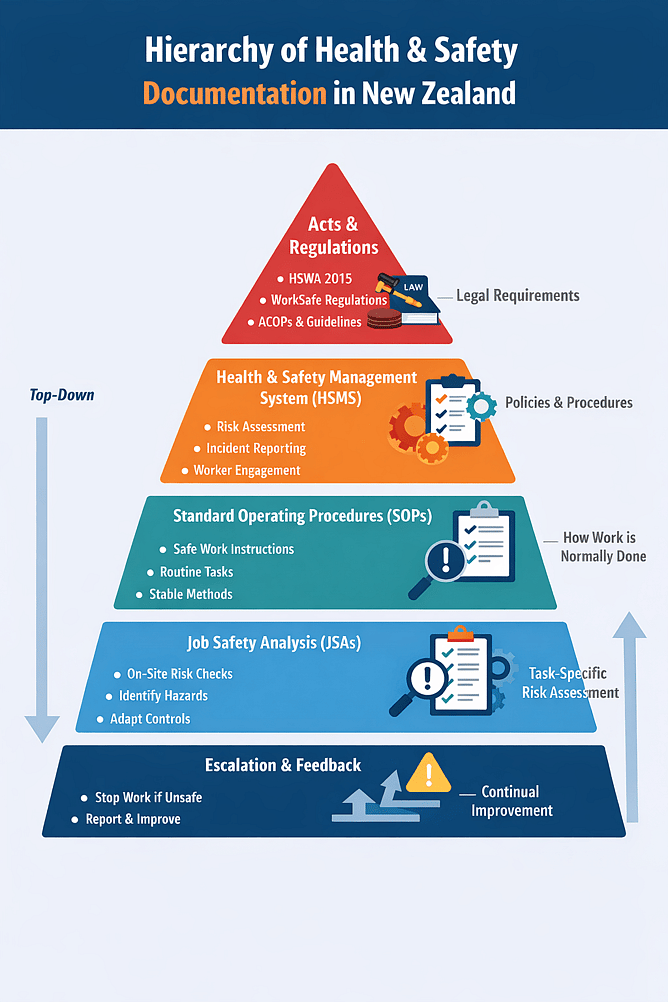
The Hierarchy of Health and Safety Documentation (HSWA-Aligned)
New Zealand health and safety documentation follows a top-down and bottom-up hierarchy.
At the top sit Acts, regulations, ACOPs and guidelines.
At the bottom sit task-level assessments completed by workers in real conditions.
Problems arise when businesses invert this hierarchy or expect task-level documents to carry legal weight they were never designed to hold.
Acts, Regulations and Codes – The Legal Foundation
At the highest level sit:
Health and Safety at Work Act 2015 (HSWA)
Health and Safety at Work Regulations
Approved Codes of Practice (ACOPs)
WorkSafe and industry guidance
Manufacturer instructions
These define what must be achieved, not how your paperwork should look.
Health and Safety Management Systems (HSMS)
A Health and Safety Management System explains how your business meets its legal duties.
This includes:
risk identification and assessment processes
incident reporting and investigation
consultation and worker engagement
monitoring, review and improvement
emergency and change management
Standards like ISO 45001 help structure this but do not replace HSWA obligations.

SOPs and SWMS – Planned, Routine Ways of Working
What Is a Standard Operating Procedure (SOP)?
An SOP describes how a task is normally done safely in your business.
SOPs:
are relatively stable
reflect legal and industry expectations
incorporate known hazards and controls
are informed by worker input
change when regulations, equipment or learning changes
They should not be rewritten daily.
What Is a SWMS in New Zealand?
In New Zealand, a Safe Work Method Statement (SWMS) is not a legal requirement.
Unlike Australia, HSWA does not mandate SWMS for high-risk construction work.
However, SWMS-style documents are commonly used as:
task method statements
administrative controls
evidence of planned work methods
Important:
A SWMS does not replace a risk assessment, nor does it satisfy HSWA on its own.
JSAs – Task-Specific Risk Assessment on the Day
What Is a Job Safety Analysis (JSA)?
A Job Safety Analysis (JSA) is a live, task-specific risk assessment completed:
before work starts
when conditions change
when work differs from the SOP
when new hazards emerge
JSAs are where real-world differences are captured.
What a JSA Is (and Is Not)
A JSA is:
a comparison between planned work and actual conditions
a mechanism to identify changed risks
a trigger for escalation if controls are inadequate
A JSA is not:
a replacement for SOPs
a generic form completed to “tick a box”
a legal shield if higher-order controls were ignored
How SOPs and JSAs Work Together (The Missing Link)
The most effective systems work like this:
SOP defines the normal, approved method
Worker reviews conditions on site
JSA identifies what is different today
Differences are controlled or escalated
Learnings feed back into SOPs
This creates continual improvement, not paperwork churn.
Why This Distinction Matters Under HSWA
HSWA requires PCBUs to:
eliminate or minimise risks so far as reasonably practicable
apply the hierarchy of controls
consult workers
manage change
verify controls work in practice
When businesses rely solely on JSAs or SWMS-style documents, WorkSafe regularly finds:
higher-order controls were never considered
risks were accepted rather than managed
documentation existed but systems failed
Common Documentation Mistakes That Fail Under Scrutiny
treating SWMS as a legal requirement
using generic JSAs for every site
updating JSAs instead of fixing SOPs
relying on administrative controls where elimination was possible
assuming experience equals competence
These are system failures, not paperwork issues.
Video: JSAs, SOPs and SWMS Explained Visually
This breakdown aligns with the explanation in our earlier video:
👉 “JSAs, JSEAs, SWMS, SOPs – What’s the Difference?”
The principles remain accurate – what has changed is the regulatory expectation around risk vs hazard and verification of controls under HSWA.
When a JSA Must Trigger Escalation
A JSA should stop work when:
residual risk remains high
controls differ materially from SOPs
weather or environment changes
equipment or access differs
workers cannot safely implement controls
If the risk cannot be reduced on site, it must be escalated – not worked around.
Final Clarification – One Sentence That Matters
SOPs define how work should normally be done.
JSAs assess what is different today.
Neither replaces the duty to eliminate or minimise risk so far as reasonably practicable.
Frequently Asked Questions
Are JSAs legally required in New Zealand?
No. JSAs are not mandated by HSWA, but they are a recognised method of task-specific risk assessment.
Is a SWMS required under HSWA?
No. SWMS are not legally required in New Zealand, but may be used as an administrative control.
Can a JSA replace a risk assessment?
No. A JSA is a form of task-level risk assessment but does not replace broader risk management duties.
Who should complete a JSA?
Workers performing the task, with input from supervisors and access to SOPs.
Can generic JSAs be used?
Only as a starting point. They must be adapted to site-specific conditions.

About the Author
Matt Jones is a HASANZ-registered health and safety consultant and the founder of Advanced Safety. He works with construction, infrastructure, manufacturing and service organisations across New Zealand to design practical, HSWA-aligned safety systems that stand up in the real world – not just on paper.