
The Difference Between a Hazard and a Risk
TLDR: A hazard is something that could cause harm. A risk is the likelihood and consequence of that harm occurring. Confusing the two is not a technical error. It is a governance weakness that leads to misallocated resources and uncontrolled exposure under pressure.
The difference between hazard and risk appears simple. In practice most organisations blur the terms. When that happens prioritisation collapses and leadership loses clarity over true exposure.
This is not about semantics. It is about control.
Book a Practical Hazard & Risk Assessment
(so you’re not just compliant but actually safer)
Contact Us TodayHazard and Risk – The Core Distinction
A hazard is a source of potential harm.
A risk is the probability and severity of that harm occurring given exposure and existing controls.
Hazards exist in the environment.
Risk reflects how well the organisation manages that environment.
Under the Health and Safety at Work Act 2015 PCBUs must manage risks so far as is reasonably practicable. The obligation is not to create longer hazard lists. It is to control exposure.
This distinction matters most at executive level.
Difference Between Hazard and Risk at Board Level
Ask each director individually:
Define a hazard.
Define a risk.
Identify our top five risks.
Do not ask in a group.
In many organisations the answers vary widely. Confidence appears quickly. Verification collapses just as quickly.
When boards lack shared understanding of risk:
Investment decisions drift
Risk appetite remains undefined
Resources are spread thinly
Officers struggle to demonstrate due diligence
Hazard awareness does not equal risk control.
"Without defined risk appetite, prioritisation becomes subjective. Risk appetite is not a compliance document. It is a decision filter."
Read more about risk appetite and why it is essential for executives, here.
Hazard and Risk, and Governance Failure
I recently reviewed a so-called hazard and risk register that listed hazards only.
Dozens of them.
When I asked management which exposures posed the greatest threat there was no clarity. Each leader had a different view. Some could not articulate any prioritisation at all.
This is common.
Without risk analysis:
Hazard registers grow
Control effectiveness is not measured
Priorities shift with noise
Exposure remains unmanaged
A forklift travelling through pedestrian walkways is not solved by debating document updates. It is solved by understanding exposure and controlling it.
Hazard lists create activity.
Risk thinking creates focus.
"Boards rarely fail because hazards exist.
They fail because exposure was misunderstood and investment was misdirected."
Case Study – Genetic Technologies ANZ
Genetic Technologies operates seed processing plants across New Zealand and Australia. I conducted a Compliance Compass™ assessment across ANZ operations to evaluate governance systems risk clarity and leadership maturity.
The outcome was not an expanded hazard list. It was a structured set of risk-assessed and prioritised recommendations.
Following the assessment:
An ANZ Health and Safety Manager was appointed
Company officers were inducted to build shared understanding of hazard and risk
A new workplace health and safety management system was drafted
A board-level performance report was introduced
The board report was designed to track diminishing risk profile not document activity.
When hazard and risk are clearly separated resource allocation sharpens. Governance visibility improves. Risk exposure reduces in measurable terms.
That is system design not compliance theatre.
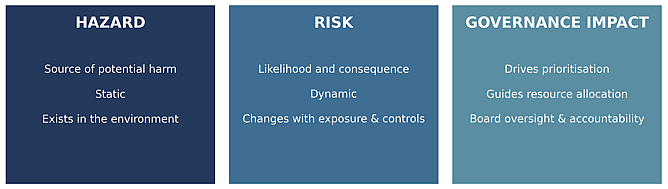
Table: The Difference Between a Hazard and a Risk
Aspect | Hazard | Risk |
|---|---|---|
Meaning | Something that can cause harm | The likelihood that harm will occur and how serious it might be |
Focus | Source of potential harm | Probability and impact of that harm |
Example | Chemicals stored in a warehouse | The risk of workers inhaling fumes or being burned |
Control | Remove or isolate the hazard | Reduce the likelihood or severity of harm |
Responsibility | Identify and list hazards | Assess and manage risks |
Difference Between Hazard and Risk Inside the S.A.F.E.T.Y.™ System
S.A.F.E.T.Y.™ is a structured lens for building safety that lasts.
Understanding the difference between hazard and risk strengthens:
Strategy – clarity around what must be protected and how risk appetite is defined.
Accountability – executive ownership of exposure rather than delegation to practitioners.
Feedback – learning from potential risk not just actual outcomes.
Execution – ensuring controls reflect operational reality.
Trust – accelerating flow of risk information upward.
Most organisations over-invest in execution and under-invest in strategic risk clarity. That imbalance creates drift.
Risk alignment at leadership level stabilises the system.

Difference Between Hazard and Risk in Mature Organisations
Organisations with developed risk leadership maturity do three things consistently:
They clearly separate hazards from risks in documentation and discussion.
They rank risks and allocate capital accordingly.
They monitor exposure trends to demonstrate diminishing risk over time.
They do not attempt to control everything equally.
They protect what matters most.
Business Benefits of Understanding Hazard and Risk
When leaders and workers understand the difference between hazard and risk, organisations benefit through:
Reduced incidents and downtime
Stronger compliance confidence
Better prioritisation of safety investment
Improved safety culture and engagement
Greater consistency across teams
Strong hazard identification combined with disciplined risk management drives performance, not just compliance.
Understanding is step one. Action is step two.
The Compliance Compass Assessment helps you:
Benchmark your current health and safety performance
Identify gaps in hazard and risk management
Receive a tailored roadmap for improvement
FAQs: The Difference Between a Hazard and a Risk
What is the difference between a hazard and a risk?
A hazard is anything that could cause harm. A risk is the chance and severity of that harm happening.
What are examples of hazards and risks in the workplace?
Hazard: a wet floor. Risk: someone slipping and being injured.
Hazard: loud noise. Risk: hearing loss over time.
Why is it important to know the difference between a hazard and a risk?
Because it helps you control dangers more effectively and meet legal duties under HSWA 2015. Governance must focus on exposure and control effectiveness not just identification of hazards.
Is a hazard register enough for compliance?
No. A hazard register without risk assessment and prioritisation does not demonstrate effective risk management.
How do you test whether your board understands risk?
Ask each director individually to define risk and identify the organisation’s top five exposures. Inconsistency reveals governance weakness.
Who is responsible for identifying hazards and managing risks?
PCBUs hold primary responsibility. Officers must exercise due diligence to ensure risk systems are effective and aligned with real exposure.
If you’re a senior leader responsible for risk governance or organisational performance and you want clarity on where your safety capability truly sits start with a structured conversation.
The Compliance Compass™ provides independent insight into governance risk systems and culture maturity.
Because safety is not paperwork.
It is leadership under pressure.
About the Author

Matt Jones is a HASANZ-registered health and safety consultant and founder of Advanced Safety. He advises directors executives and senior leaders on governance accountability risk leadership maturity and the design of safety systems that hold under pressure.
He developed the S.A.F.E.T.Y.™ framework to help organisations move from reactive compliance to intentional system design strengthening clarity ownership feedback loops and control across high-risk environments.
Recommend Further Reading
Last updated: 13 February 2026