Management of Change (MOC) in Health and Safety: What NZ Businesses Need to Get Right
Management of change (MOC) is one of the most misunderstood - and most frequently missed - health and safety obligations in New Zealand workplaces.
It is also a recurring theme in serious incidents, prosecutions, and regulatory investigations. Not because organisations ignore safety entirely, but because change quietly invalidates existing controls.
This article updates and corrects earlier guidance, aligns fully with the Health and Safety at Work Act 2015 (HSWA) and ISO 45001, and answers the most common questions appearing in Google’s People Also Ask results.
What Is Management of Change (MOC)?
Management of change is the structured process used to identify, assess, and control health and safety risks introduced when something changes at work.
In a New Zealand context, MOC is not a standalone legal term, but it is clearly required by HSWA. PCBUs must ensure risks are managed so far as is reasonably practicable - and that duty applies before, during, and after change.
Change can invalidate existing risk assessments, procedures, training, and emergency plans. MOC exists to prevent organisations from assuming that “what worked before” will still work after conditions shift.
Short answer: Management of change is the process of reassessing risk whenever work conditions, systems, people, or environments change, to ensure controls remain effective.

Why Managing Change Matters for Health and Safety
Most serious incidents do not occur during unfamiliar work. They occur when:
equipment is upgraded or modified
layouts or access points change
work methods evolve incrementally
responsibilities shift between roles or contractors
assumptions go unchallenged
Without MOC, these changes create hidden risk.
Under HSWA, failing to reassess risk during change can expose PCBUs and officers to enforcement action, even where existing systems appear compliant on paper.
Legal Responsibilities Under HSWA During Change
HSWA does not use the term “management of change”, but the requirement is embedded throughout the Act.
PCBUs must:
identify new or changed hazards
assess risks arising from change
consult with affected workers
implement effective controls
verify that controls work in practice
Officers must exercise due diligence, which includes ensuring systems remain appropriate when conditions change.
Key point: if a change introduces new risk and it was not reassessed, the organisation is exposed.

Types of Changes That Require MOC
Physical Changes
new or modified plant and equipment
altered layouts, access ways, or work heights
new substances, materials, or structures
Operational Changes
new or revised procedures
changes to maintenance or isolation practices
introduction of new technology or software
People and Organisational Changes
new workers or contractors
role changes or restructures
reduced supervision or experience
If the change affects how work is done, MOC should be triggered.
Best Practice: How to Manage Change Safely
Step 1: Define the Change
Clearly describe what is changing, why, and who will be affected. Vague change descriptions lead to missed risks.
Step 2: Reassess Risk
Review hazards using current conditions - not historical assumptions. Consider interaction between people, equipment, environment, and tasks.
Step 3: Apply the Hierarchy of Controls
Eliminate or engineer out risk where possible. Do not default to administrative controls or PPE.
Step 4: Consult and Communicate
Worker consultation is a legal requirement. Those doing the work often identify risks missed at planning stage.
Step 5: Verify and Review
Confirm controls are implemented and effective. Review again if conditions change further.
The Role of Leadership in Management of Change
Leadership failures in MOC are rarely intentional. More often they involve:
assuming minor changes are low risk
delegating risk assessment without oversight
failing to verify that controls still work
Effective leaders ensure that change triggers deliberate pause and reassessment, not rushed implementation.
How ISO 45001 Supports Management of Change
ISO 45001 explicitly requires organisations to manage change in a controlled manner.
Key elements include:
risk-based planning
worker participation
continual improvement
documented verification
For organisations aligned to ISO 45001, MOC should already be embedded in system design.
Common Challenges With MOC - And How to Avoid Them
Change fatigue: treat MOC as proportional, not bureaucratic.
Missed incremental change: review systems periodically, not only during major projects.
Paper compliance: verify controls through observation, not documentation alone.
Frequently Asked Questions About Management of Change
What do you mean by management of change?
Management of change is the process of reassessing health and safety risks whenever work conditions, systems, people, or environments change.
What is MOC with an example?
If new equipment is installed, MOC requires reassessing hazards, updating procedures, retraining workers, and verifying controls before use.
What is the difference between change management and management of change?
Change management focuses on people and performance. Management of change focuses on risk and safety impacts of change.
What are the 5 principles of management of change?
Identify the change
Assess risk
Apply controls
Consult workers
Verify effectiveness
Why MOC Failures Lead to Serious Incidents
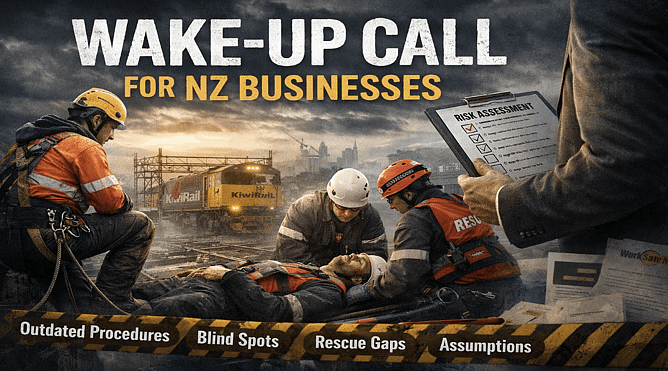
Most prosecutions linked to change involve:
outdated procedures
untested assumptions
controls that no longer match reality
Management of change exists to prevent learning these lessons after someone is harmed.
Recent New Zealand enforcement cases show these questions are not theoretical.
In the KiwiRail prosecution, WorkSafe made it clear that introducing new infrastructure without reassessing task-specific risk exposed workers to serious harm. The issue was not reckless behaviour, but assumptions that existing controls still applied.
Similar patterns have emerged in New Zealand port operations, where changes to plant, traffic management, and contractor interfaces have led to enforcement action when risk assessments and controls were not revisited.
In both settings, the regulator’s focus was not on documentation volume, but on whether risk had been actively reconsidered as conditions changed.
Final Thoughts
Management of change is not about slowing work down. It is about keeping systems aligned with reality.
Organisations that manage change well rarely do more paperwork. They ask better questions at the right time.
About the Author

Matt Jones is a HASANZ-registered health and safety consultant and founder of Advanced Safety. He works with construction, infrastructure, manufacturing and service organisations across New Zealand to design practical, HSWA-aligned safety systems that stand up in real operating environments - not just on paper.