What the Health and Safety Amendment Bill 2026 Actually Changes
The Health and Safety Amendment Bill 2026 does not dismantle HSWA. It reorients it.
The reform shifts emphasis toward identifying and prioritising “critical risks” (hazards likely to cause death or serious harm) and introduces a more structured framing of officer due diligence.
For competent boards, little should change.
For organisations relying on broad paperwork and unverified confidence, exposure may increase.
What Has Actually Changed Under the Health and Safety Amendment Bill 2026
The core HSWA framework remains.
What changes is emphasis.
The Bill:
Introduces Schedule 1A hazard categories
Defines “critical risk” more explicitly
Clarifies that small PCBUs may focus only on critical risks
Requires larger PCBUs to manage all risks but prioritise critical ones
Reframes officer duties into three clear pillars
Elevates the evidentiary weight of Approved Codes of Practice
This is not deregulation.
It is reorientation.
And reorientation increases the importance of correct interpretation.
Critical Risk Under the Health and Safety Amendment Bill 2026
A critical risk is one that:
Is associated with a Schedule 1A hazard
Is likely to cause death or serious harm
Is assessed based on what the PCBU knows or ought reasonably to know
Schedule 1A hazards include activities such as:
Work at height
Scaffolding
Excavation
Cranes
Mining
Petroleum operations
Major hazard facilities
Mobile plant
Hazardous substances
Occupational diving
Notice what is not explicitly captured:
Psychosocial harm
Bullying
Slips on level surfaces
General fatigue
Ergonomic strain
These do not disappear as risks.
But they may not meet the Schedule 1A threshold.
That distinction creates tension.

The Two-Speed System – Small vs Other PCBUs
Under the Bill:
Small PCBUs (under 20 workers):
Required to manage critical risks only
Other PCBUs:
Must manage all risks
Must prioritise critical risks
This is a major governance inflection point.
Risk now sits in classification accuracy.
Misclassification becomes the new exposure.
Discover the difference between hazard and risk.
What “Prioritise Critical Risk” Now Legally Means
Prioritisation is not rhetorical.
It has operational consequences:
Sequence
Critical risks addressed before minor risks
Frequency
Critical risks monitored more often
Resources
Budget and leadership attention aligned to critical risk
Governance
Board visibility elevated
In one ANZ enterprise engagement, a Compliance Compass deep-dive review exposed fragmented risk prioritisation across jurisdictions.
Following presentation of findings:
An ANZ WHS Manager role was created
Hazardous substances exposure was restructured
Mobile plant interaction risks were redesigned
Crushing risks were engineered out
Within 12 months, measurable risk profile reduction occurred.
That is prioritisation in action.
Not language.
Allocation.
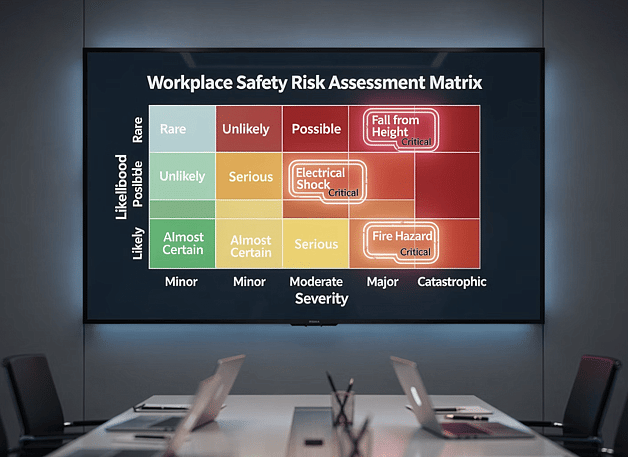
WorkplaceSafety Risk Assessment Matrix
Officer Duties Under the Health and Safety Amendment Bill 2026
Section 44 now clarifies due diligence into three pillars:
Understand
Ensure
Verify
Understand
Officers must understand operations and associated hazards.
Ensure
Officers must ensure resources, processes, and reporting systems are in place.
Verify
Officers must verify that controls and systems are actually functioning.
This makes officer conduct more measurable, not less.
ACOP Safe Harbour – A Strategic Shift
Approved Codes of Practice now carry stronger evidentiary status.
Following an ACOP creates a presumption of compliance.
This is significant.
However:
Meeting an ACOP is not excellence.
It is the legal floor.
In my experience, organisations that treat ACOP as the finish line plateau.
Those that treat it as baseline continue improving.
Continual improvement is what separates legally compliant businesses from operationally resilient ones.
Safe harbour reduces litigation risk.
It does not guarantee performance under pressure.
Where Legal Exposure Now Shifts
The Amendment Bill does not remove risk.
It relocates it.
Exposure now sits in:
Incorrect classification of critical risk
Superficial prioritisation
Governance complacency
Over-reliance on paperwork
ACOP treated as ceiling not floor
Boards that misunderstand this will believe they have simplified.
In reality, they may have narrowed their vision.
What the Health and Safety Amendment Bill 2026 Means for NZ Boards
For competent governance teams:
This reform should tighten focus.
For reactive organisations:
It may amplify blind spots.
The question is not:
“Is the Bill good or bad?”
The question is:
“Do we understand our exposure under it?”
Frequently Asked Questions – Health and Safety Amendment Bill 2026
What is the Health and Safety Amendment Bill 2026?
The Health and Safety Amendment Bill 2026 proposes changes to HSWA aimed at narrowing regulatory focus toward critical risks and reducing perceived compliance burden.
Does the Bill remove the need for risk assessments?
No. Businesses will still need to identify and manage risks, but the scope and expectations may become less clear rather than more defined.
Who decides what a critical risk is?
Under the proposed changes, businesses are expected to make this determination themselves, based on their understanding of work activities and potential harm.
Does the Health and Safety Amendment Bill 2026 remove responsibility for non-critical risks?
No.
For larger PCBUs, the duty to manage all risks remains. The Bill requires critical risks to be prioritised, not that other risks be ignored.
For small PCBUs, the focus may narrow to critical risks, but this does not remove the general duty to ensure health and safety so far as is reasonably practicable. Misinterpreting this distinction could create significant exposure.
Does the Health and Safety Amendment Bill apply to all industries?
Yes, although the practical impact will vary significantly depending on sector, risk profile, and organisational capability.
Does following an Approved Code of Practice (ACOP) guarantee compliance under the Health and Safety Amendment Bill 2026?
Following an ACOP creates a presumption of compliance, often referred to as “safe harbour.”
However, ACOPs represent the minimum expected standard. They do not replace the duty to continuously assess whether controls remain effective in your specific operational context.
ACOP compliance may reduce evidentiary risk in enforcement proceedings, but it does not guarantee that your system will perform under pressure.
What should officers do now?
Officers should continue to actively understand operations, verify controls, and ensure resources are available - regardless of proposed wording changes.
Final Thoughts
The Health and Safety Amendment Bill 2026 is being promoted as simplification.
Simplification only works if capability is strong.
If risk literacy is weak, simplification increases interpretation risk.
If governance is mature, this reform sharpens focus.
If governance is symbolic, it increases exposure.
Safety outcomes are not shaped by slogans.
They are shaped by disciplined leadership under pressure.
About the Author

This article was written by Matt Jones, a HASANZ-registered health and safety professional and founder of Advanced Safety.
Matt advises New Zealand business leaders on practical health and safety system design, HSWA compliance and risk management, with a focus on construction, manufacturing, and complex operational environments. He is also the host of the Health and Safety Unplugged podcast, where he speaks with industry leaders about real-world safety challenges and emerging practice.
Advanced Safety is a New Zealand-based workplace health and safety consultancy providing compliance audits, ISO 45001-aligned systems, risk assessments, and ongoing safety management support for construction, manufacturing and commercial businesses.
Links:
Matt Jones – LinkedIn
Advanced Safety – https://www.advancedsafety.co.nz/
Health and Safety Unplugged (YouTube) – https://www.youtube.com/@advancedsafety