Why Safety Systems Fail
Safety systems fail under pressure when documented controls are not embedded in leadership behaviour, operational practice, worker voice, verification routines, and governance oversight.
Most failures are not caused by missing paperwork.
They are caused by a gap between what leaders believe is happening and what is actually occurring on site.
That gap is where health and safety liability lives.
The 6:47am Phone Call

Your phone rings.
There’s been an incident.
Nothing catastrophic, thankfully. But WorkSafe is on their way.
Suddenly every policy you’ve signed feels theoretical. Every board report feels incomplete. Every assurance conversation feels untested.
This is where safety systems are revealed.
Not during audits.
Not during tenders.
Not during toolbox talks.
Under pressure.
Under scrutiny.
Under consequence.
And too often, this is the moment organisations discover their system performs well on paper but fractures in reality.
Why Safety Systems Fail Under Pressure – Sign One
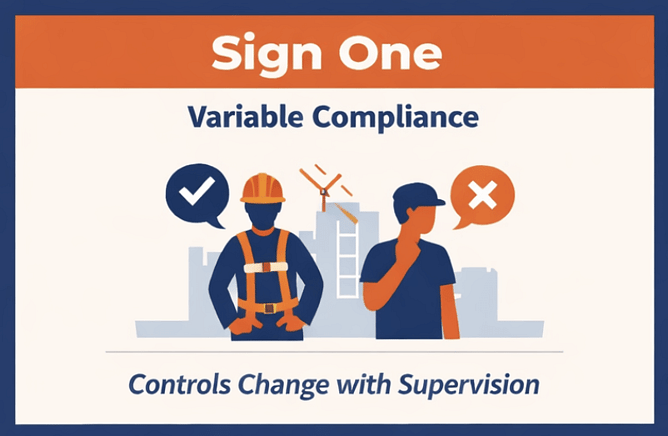
Controls Exist, But Implementation Varies
If harness use depends on who is watching, your system is performative.
If permits are followed during audits but streamlined under deadlines, your controls are conditional.
If PPE appears during walkthroughs and disappears during routine operations, your safety culture is observational, not embedded.
This variability signals something deeper than rule-breaking.
It signals that leadership has not successfully embedded non-negotiable standards.
WorkSafe does not assess intent.
They assess behaviour.
A system that only functions under supervision is not robust.
It is fragile.
Why Safety Systems Fail Under Pressure – Sign Two
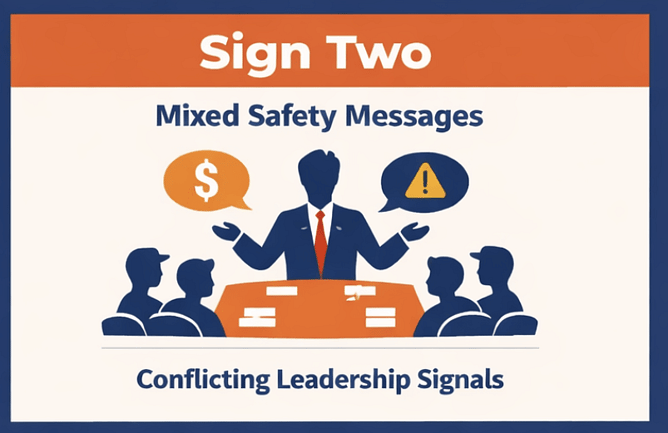
Leadership Sends Mixed Safety Signals
Under HSWA 2015, officer due diligence cannot be delegated.
Yet the most common safety system failure I see begins in subtle leadership contradictions.
A project proceeds before review is complete.
A senior leader refers to “safety bureaucracy.”
Deadlines are celebrated without confirming risk controls were maintained.
Workers are intelligent observers.
They quickly understand which commitments are aspirational and which are non-negotiable.
When production consistently outranks protection in behaviour, your safety system has already been deprioritised — regardless of what your policy states.
This is not cultural softness.
This is governance drift.
Why Safety Systems Fail Under Pressure – Sign Three
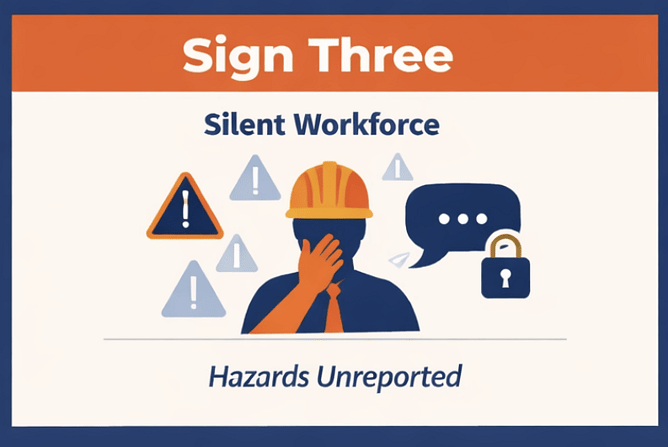
Workers Stay Silent
The most dangerous hazards are not the ones reported.
They are the ones workers decided were not worth reporting.
When workers believe:
Nothing changes
Reporting slows work
Raising concerns damages reputation
Management already “knows”
Silence becomes rational.
Under HSWA, worker engagement is not optional.
But psychological safety cannot be created by procedure.
If reporting does not produce visible action, reporting dies.
And when reporting dies, your board reports become fiction.
Why Safety Systems Fail Under Pressure – Sign Four
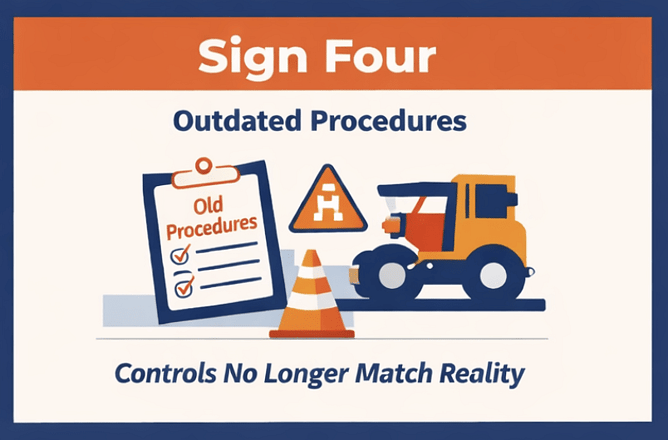
The System Has Drifted From Operational Reality
Safety management systems have expiry dates.
New equipment.
Modified workflows.
Contractor changes.
Client-driven process shifts.
Operational reality evolves faster than documentation.
Unless verification is active and structured, a dangerous divergence develops:
The documented system describes one set of controls.
The real operation runs on another.
This is where ISO 45001 certification can create false comfort.
Certification confirms your system met a standard at a point in time.
It does not guarantee your current controls reflect today’s exposure.
Verification must be deliberate.
Walk the site.
Compare procedure to practice.
Test controls.
Challenge assumptions.
Without that discipline, your safety management system becomes historical documentation.
Why Safety Systems Fail Under Pressure – Sign Five
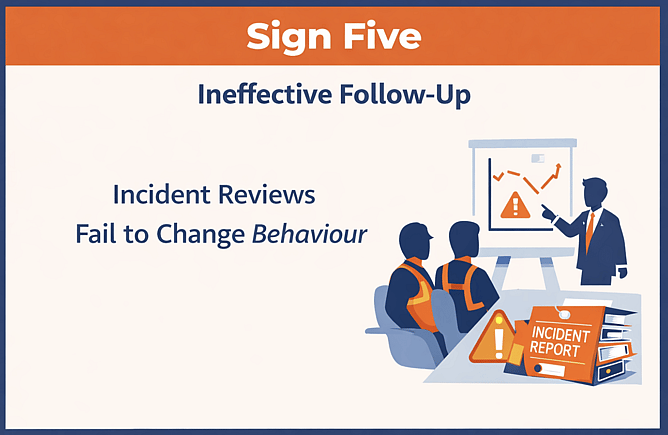
Incident Reviews Don’t Change Behaviour
If incidents repeat, learning has failed.
Most investigations identify immediate causes.
Few interrogate systemic drivers:
Leadership pressure
Resource constraints
Workflow design
Conflicting KPIs
Cultural normalisation of shortcuts
Retraining alone does not fix structural drivers.
When incident reviews focus on paperwork updates rather than systemic correction, risk remains.
A mature safety system evolves.
A fragile one documents.
The Governance Gap – Where Director Exposure Lives
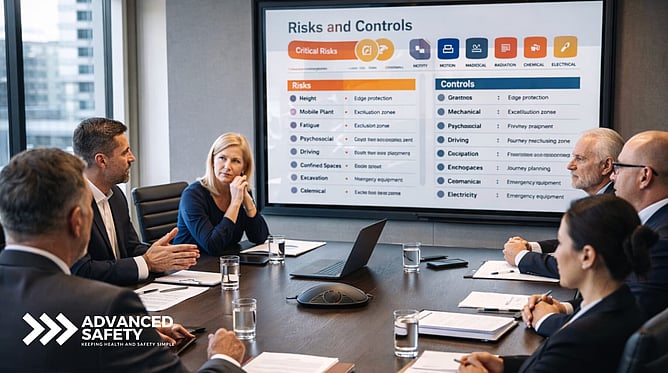
Across all five signs, a common pattern emerges:
Leaders believe the system is stronger than it is.
This is not negligence.
It is distance.
Board reporting often focuses on:
Lag indicators
Administrative compliance
Training completions
Audit percentages
Meanwhile, the real questions remain unanswered:
What are our critical risks?
Are critical controls verified?
Where are controls degrading?
What behaviours are being normalised?
What are workers not telling us?
This is where officer liability becomes real.
Under HSWA 2015, due diligence requires that officers:
Acquire up-to-date knowledge
Understand operations and associated risks
Ensure appropriate resources and processes
Verify implementation
Verification is the difference between confidence and assumption.
The Safety System Maturity Question
Safety systems operate across maturity zones:
Reactive
Systematic
Proactive
Integrated
The problem is not being in a lower zone.
The problem is believing you are in a higher one.
Most organisations overestimate their maturity because documentation exists.
Maturity is not measured by paperwork.
It is measured by consistency under pressure.
The Cost of Getting This Wrong

The cost is not just regulatory.
It is strategic.
Tender exclusion
Director prosecution
Reputational damage
Operational shutdown
Insurance implications
Talent attrition
But most significantly:
Loss of trust.
When workers lose trust in the safety system, performance declines.
When regulators lose trust in governance, scrutiny increases.
When boards lose trust in reporting, confidence fractures.
What Strong Governance Looks Like Under Pressure

Strong systems demonstrate:
Critical risks clearly defined
Critical controls assigned and owned
Control effectiveness routinely verified
Reporting structured around exposure not activity
Leadership behaviour aligned with stated priorities
Workers confident that raising concerns leads to action
This is not theoretical maturity.
It is observable discipline.
The Question That Matters
If WorkSafe arrived tomorrow, could you:
Clearly articulate your top five critical risks?
Explain how each is controlled?
Demonstrate verification routines?
Show evidence of recent challenge?
Identify your weakest maturity pillar?
If not, the system may be more hopeful than resilient.
Safety is not paperwork.
It is leadership under pressure.
Frequently Asked Questions – Why Safety Systems Fail Under Pressure
What causes safety systems to fail under pressure?
Safety systems fail when there is a gap between documented controls and actual operational behaviour.
Most failures are not due to missing policies. They occur when:
Leadership behaviour contradicts stated priorities
Critical controls are not verified
Workers stop reporting concerns
Governance assumes compliance without evidence
Failure under pressure reveals weaknesses that were already present.
How do I know if my safety system is performative rather than embedded?
A performative safety system shows signs such as:
PPE use changes depending on supervision
Procedures are followed during audits but relaxed during deadlines
Workers comply when observed but improvise when unobserved
Board reports focus on activity rather than exposure
An embedded system demonstrates consistency regardless of oversight.
Why do directors face personal risk when safety systems fail?
Under the Health and Safety at Work Act 2015, officers have a positive duty of due diligence.
They must:
Acquire and maintain knowledge
Understand operational risks
Ensure appropriate resources
Verify controls are implemented
If verification does not occur, directors may be exposed even when policies exist.
Liability attaches to governance failure, not just operational mistakes.
What is the difference between compliance and capability in safety management?
Compliance focuses on documentation and meeting minimum legal standards.
Capability focuses on:
Control effectiveness
Leadership alignment
Cultural integrity
Continuous improvement
Verification discipline
An organisation can be compliant and still fragile.
Capability determines whether the system performs under pressure.
How often should safety systems be verified against real operations?
Verification should occur:
When operational changes occur
When new equipment or contractors are introduced
After incidents
At structured intervals determined by risk profile
Annual review alone is insufficient in high-risk environments.
Verification must be ongoing and evidence-based.
What are the warning signs that leadership messages are undermining safety?
Common indicators include:
Safety described as bureaucracy
Deadlines celebrated without confirming control integrity
Resource allocation prioritising production over risk reduction
Senior leaders bypassing procedures
Workers quickly detect misalignment between words and actions.
Behaviour sets the real standard.
What should executives focus on to prevent system failure?
Executives should prioritise:
Clear definition of critical risks
Identification and ownership of critical controls
Routine verification of control effectiveness
Honest board reporting
Psychological safety for worker voice
Prevention is driven by leadership clarity, not administrative volume.
Executive Call to Action
If you are a director, executive, or senior leader responsible for governance, do not wait for the 6:47am phone call to discover your actual exposure.
The Compliance Compass™ provides an independent maturity assessment across:
Governance and officer due diligence
Critical risk and control verification
Operational system alignment
Culture and reporting effectiveness
Not a checklist.
A structured benchmark.
Because safety systems do not fail during calm periods.
They fail when tested.
Raise the standard.
About the Author

This article was written by Matt Jones, a HASANZ-registered health and safety professional and founder of Advanced Safety.
Matt works with directors, executives and senior leaders across New Zealand to strengthen governance accountability, critical risk control and safety system performance under pressure. His focus is not paperwork. It is clarity of leadership, control integrity and measurable risk reduction in construction, manufacturing and complex operational environments.
He is the creator of the S.A.F.E.T.Y.™ framework and the Compliance Compass™, both designed to help organisations move beyond reactive compliance toward deliberate, high-performance safety leadership.
Matt also hosts the Health and Safety Unplugged podcast, where he speaks with industry leaders about governance, risk maturity and the realities of safety in demanding operational settings.
Advanced Safety is a New Zealand-based consultancy providing independent governance reviews, ISO 45001-aligned systems, critical risk diagnostics and ongoing advisory support for organisations serious about raising their standard.
Connect and learn more:
Matt Jones – LinkedIn
Advanced Safety – https://www.advancedsafety.co.nz
Health and Safety Unplugged (YouTube) –
021 194 3437