AI in health and safety is no longer a future concept, it's already being used to identify risk, predict incidents, monitor behaviour and surface insights that traditional systems simply can't.
But as interest in AI in health and safety accelerates, so does confusion.
Many organisations are asking the same questions:
What does AI actually do in a safety context?
Where does it add real value and where does it create new risk?
How do PCBUs adopt AI responsibly without outsourcing judgment or accountability?
These questions sit at the heart of Season 5, Episode 3 of the Health and Safety Unplugged podcast, where I sat down with Tane van der Boon, founder of Inviol, to talk about what AI means for real-world safety systems. We kept it to practice, not theory, hype or vendor-driven promises.
The Role of AI in Health and Safety Today
AI in health and safety supports better decision-making by analysing data at scale, picking up patterns people miss and highlighting risk earlier. It doesn't replace professional judgment or PCBU accountability.
AI tools are increasingly being used in safety systems to:
analyse large volumes of safety data
detect trends across incidents, near misses and observations
support earlier intervention before harm occurs
provide consistency where manual systems struggle
In the podcast, Tane makes a critical distinction: AI is most powerful when it augments human capability, not when it attempts to replace it.
That framing matters under the Health and Safety at Work Act 2015, where section 31 says a duty can't be transferred to another person, let alone to a piece of software. AI can inform decisions, however responsibility always stays with the PCBU.
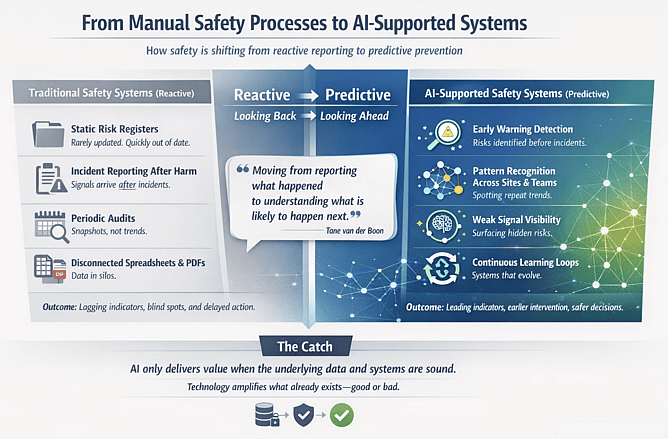
From Manual Safety Processes to AI-Supported Systems
Most organisations still rely heavily on manual safety processes:
static risk registers
incident reporting after harm has occurred
periodic audits that offer snapshots, not trends
spreadsheets and PDFs that don't talk to each other
AI changes this by shifting safety systems from reactive to predictive.
Instead of waiting for incidents to signal failure, AI-supported platforms can:
identify early warning signs
highlight repeat patterns across sites or teams
surface weak signals that would otherwise remain invisible
In the interview, Tane describes this as moving from reporting what happened to understanding what is likely to happen next.
That shift is significant, however it only works when the underlying data and systems are sound.
Why AI in Health and Safety Is Gaining Momentum
AI adoption in health and safety is accelerating for several reasons.
Predictive Risk Management Using AI in Health and Safety
AI picks up risk earlier by analysing trends across incidents, behaviours and conditions before anyone is hurt.
Traditional systems tend to focus on lag indicators. AI allows organisations to interrogate lead indicators at scale.
This is particularly relevant in complex environments where:
work changes frequently
contractors are involved
risk exposure varies day to day
manual oversight has limits
Real-Time Monitoring and AI in Health and Safety Systems
AI-powered tools increasingly support real-time insights through:
sensor data
digital permits
behavioural observation platforms
operational system integration
However, as discussed in the podcast, real-time data is only valuable if there is governance around how it is used.
More data doesn't automatically mean better safety outcomes.
Reducing Human Error Without Removing Human Judgment
AI can reduce cognitive load and inconsistency, however it can't replace contextual understanding or ethical decision-making.
One of the strongest insights from the conversation with Tane is that AI doesn't remove error, it changes where error occurs.
If the inputs are flawed, biased or incomplete, AI will scale those weaknesses.
This is why AI must sit within:
clear decision-making frameworks
defined escalation pathways
competent human oversight
Cost Efficiency and Resource Allocation
AI can also reduce the administrative burden on a safety team by:
automating analysis
prioritising issues that matter most
reducing time spent searching for insights
That efficiency is attractive, however it only counts when it supports better control selection and not just faster reporting.
Compliance and AI in Health and Safety
When it comes to compliance, AI can assist with:
identifying gaps against expected standards
highlighting misalignment between practice and documentation
supporting internal assurance processes
What it can't do is create compliance by default.
As we discussed in the podcast, regulators look at outcomes, decisions and systems, not at whether you've adopted the latest software.
AI in Health and Safety Requires Governance, Not Just Technology
One of the most important themes in the interview is governance.
Before adopting AI tools, organisations should be able to answer:
What decisions will AI inform?
What decisions will always remain human-led?
How are outputs validated?
How is bias managed?
How is data quality assured?
Without clear answers to those questions, AI risks becoming:
a false sense of security
an unchallenged authority
a compliance blind spot
This is where many early adopters stumble.
Expert Insight: Tane van der Bloon on AI and Safety Systems
Tane brings a grounded perspective shaped by operational reality, not Silicon Valley optimism.
A recurring message throughout the episode was about where AI actually sits:
“AI is only as good as the system it sits within.”
Strong safety outcomes still rely on the same fundamentals:
well-designed risk frameworks
clear accountabilities
effective application of the hierarchy of controls
leadership engagement
AI can strengthen those systems, it doesn't replace them.
Where AI Fits - and Where It Does Not
AI in health and safety adds the most value when:
data is consistent and reliable
risk is dynamic and complex
early intervention matters
insights are acted on
AI adds the least value in a business when:
organisations are trying to compensate for weak fundamentals
documentation does not reflect reality
leadership is disengaged
risk controls rely on behaviour alone
This distinction is critical for business leaders considering adoption.
AI in Health and Safety and PCBU Accountability
Using AI in health and safety doesn't reduce PCBU duties at all, if anything it raises the expectation that risks are understood and managed proactively.
If AI surfaces risk indicators and those indicators are ignored, accountability doesn't disappear.
In fact the exposure may well increase when the PCBU had the warning in front of it and didn't act.
That's why AI needs to be built into decision-making processes and not bolted on as a reporting tool.
Why AI in Health and Safety Won't Fix Blind Spots on Its Own
The core argument in my book Raise the Standard is that good organisations rarely fail for lack of caring or lack of paperwork. They fail because leaders gradually lose sight of what's really happening at the coal face. The only fix that lasts is architecture deliberately designed to keep that sight. I put it in three beats: visibility is the problem, drift is the mechanism and architecture is the answer.
AI in health and safety sits squarely inside that argument. A tool that spots weak signals earlier can genuinely improve visibility and that's exactly what Tane and I talked about. Point the same tool at a system that has already drifted and it'll analyse documents that don't match the work and dashboards that report what people think is happening. You end up with faster blindness, not better sight.
So before you buy the tool, ask a simpler question. If the AI surfaced your most serious risk tomorrow, who would see it, who would own it and how would you know the control was actually working?
The free G.A.P.E. Self-Assessment is a good place to start before you add AI on top. It looks at what leaders believe, what the documents say, what people actually do and what you can prove, then shows you where those four have drifted apart.
Common Questions About AI in Health and Safety
Is AI required to meet HSWA obligations?
No, AI isn't required, however a PCBU must manage risk so far as is reasonably practicable under the Health and Safety at Work Act 2015. AI may support that duty where it suits the work.
Can AI replace safety advisors or consultants?
No, AI supports analysis but it doesn't replace professional judgment, leadership or accountability.
Is AI suitable for all industries?
Not always, high-variability and data-rich environments tend to benefit most.
Does AI improve safety culture?
Only when it's paired with leadership, engagement and good system design.
Watch the Full Conversation: Health and Safety Unplugged
There's a lot more in the full conversation than I've covered here.
In Season 5, Episode 3 of Health and Safety Unplugged, Tane van der Boon and I explore:
where AI genuinely improves safety outcomes
where organisations are getting it wrong
what responsible adoption looks like in practice
If you're considering AI in your safety system, look for the episode How AI Is Quietly Preventing Workplace Deaths (Before Anyone Gets Hurt) wherever you get your podcasts. It'll help you separate value from noise.
Final Thought: AI Is a Tool, Not a Strategy
AI will continue to shape health and safety practice in New Zealand.
But strong outcomes will always depend on:
system design
leadership decisions
practical application of controls
willingness to reassess assumptions
AI can strengthen those foundations, however it can't replace them.
About the Author

Matt Jones is the founder of Advanced Safety and a HASANZ-registered health and safety consultant. He's a Professional Member of NZISM and holds a Graduate Diploma in Occupational Safety and Health.
He advises boards, directors and executives on officer due diligence and critical risk under the Health and Safety at Work Act 2015. His book Raise the Standard: Why Good Organisations Go Blind and How Leaders Restore Visibility sets out G.A.P.E.™, F.E.E.D.™ and S.A.F.E.T.Y.™, a leadership architecture framework for high-risk organisations.
He created the Compliance Compass audit and hosts the Health & Safety Unplugged podcast.
Keep reading
Governance Advisory
Is the health and safety report your board reads actually true?
Your officers carry a personal due diligence duty under the Health and Safety at Work Act 2015. Governance Advisory puts an independent view over your critical risk reporting every month and a short paper in front of your board every quarter, giving the people who sign off a true picture of what’s going on.
Start with the free Officer Due Diligence Check or read the Colliers Project Leaders case study.
Latest update: 5 November 2026