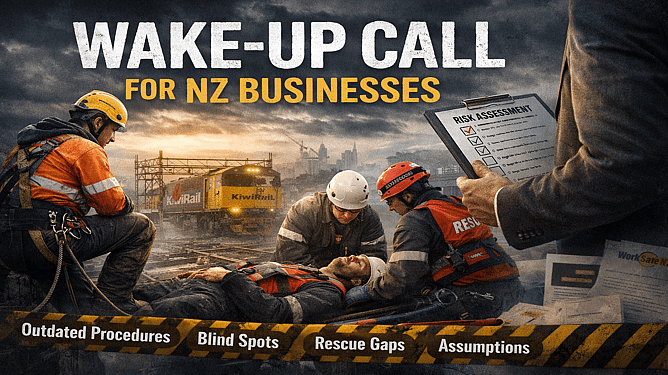
The KiwiRail prosecution shows that when infrastructure changes, existing safety procedures may no longer be adequate. WorkSafe expects businesses to reassess the risk when something new comes in, consider safer options before relying on fall arrest and stop leaning on assumptions or legacy documentation.
Every New Zealand business leader should understand the KiwiRail prosecution brought by WorkSafe NZ. It didn't involve reckless behaviour, it involved competent people, familiar work and assumptions that no longer held true.
This is exactly where many serious and life-altering workplace incidents occur.
The prosecution isn't really a rail safety story, it's a risk management story with lessons well beyond rail for construction, manufacturing, logistics, utilities, property, retail, agriculture, events and professional services.
What Happened in the KiwiRail Prosecution: In Plain Terms
In October 2023 a KiwiRail worker installing a telecommunications pole in Whanganui fell ten metres. He suffered a torn artery, a torn liver, a broken sternum, a punctured lung, nine fractured vertebrae and five fractured ribs. He later developed blood clots in his legs that needed surgery.
Workers had climbed poles to do this kind of job before, however those had been wooden poles and the one he was on was a new design for KiwiRail.
The infrastructure had changed and that turned out to be the critical difference.
KiwiRail had introduced the Oclyte telecommunications pole, a new design that changed the risk of climbing it. WorkSafe's view was that existing procedures couldn't be assumed to cover it and that the change called for a full risk assessment.
WorkSafe's investigation into the fall found that:
No detailed, job-specific risk assessment was carried out for the new pole design.
No dedicated procedures were developed for the new infrastructure.
Workers hadn't been trained in risk assessment for complex work at height.
Safer options higher up the hierarchy, such as a mobile elevated work platform, weren't provided.
The climbing pegs on the pole had been incorrectly installed.
A fall arrest system had been installed but wasn't in use at the time.
KiwiRail was fined $220,000 and ordered to pay $28,500 in reparation. The worker spent around 10 months recovering before he could return to work.
Why the KiwiRail Prosecution Matters Beyond Rail

This prosecution has little to do with rail operations and a lot to do with how organisations manage risk when conditions change.
Plenty of serious incidents happen during work that doesn't look dangerous or unfamiliar at all. They tend to happen when:
infrastructure is modified incrementally
work methods remain largely unchanged
legacy procedures are reused without reassessment
training is assumed to still be adequate
emergency and rescue arrangements exist only on paper
It's worth asking whether your organisation has:
added new plant, structures or systems
modified access ways, layouts or working heights
introduced new equipment into existing environments
relied on contractors to manage change without internal oversight
continued using the same procedures year after year
If it has, the KiwiRail prosecution is directly relevant to you.
What WorkSafe Reinforced Through the KiwiRail Prosecution
WorkSafe's statement on the sentencing was short and pointed, with central regional manager Nigel Formosa stressing that new infrastructure needs a fresh risk assessment and that fall arrest should be the last line of defence. The themes below build on that and on WorkSafe's wider guidance.
Risk Must Be Reassessed When Conditions Change
WorkSafe made it clear that new infrastructure means existing procedures can't simply be assumed to still work.
Even modest changes to infrastructure, equipment, or layout can render existing controls ineffective.
Statements such as “we’ve always done it this way” or “this task is familiar” offer no protection once the context has changed. Risk assessments must reflect how work is actually performed today, not how it was performed when procedures were originally written.
Incremental change still needs a conscious reassessment, even when each step looks too small to matter.
The Hierarchy of Controls Must Be Actively Applied
The prosecution reinforced that fall arrest shouldn't be the default control where safer options are reasonably practicable.
WorkSafe expects organisations to actively consider whether work can be:
eliminated
completed from ground level
undertaken using elevated work platforms or scaffolding
Fall arrest systems sit lower in the hierarchy and shouldn't be relied on as the primary control where higher-order controls are available.
This lines up with the HSWA 2015 duty to eliminate risks so far as is reasonably practicable and to minimise them where elimination isn't reasonably practicable.
Learn more about the hierarchy of controls.
Training Must Be Specific, Current and Task-Relevant
Experience isn't the same as competence once the conditions have changed.
In the KiwiRail case, WorkSafe found workers hadn't been trained in risk assessment for complex work at height. Nothing in the training or the procedures had caught up with the new pole.
Training holds up best when it's built to:
address the actual task being performed
reflect current conditions
be refreshed when work methods or environments change
Generic or legacy training is increasingly difficult to defend.
Rescue Planning Must Work in Reality, Not Just on Paper
One of the most uncomfortable truths in work-at-height incidents is that many rescue plans are theoretical.
WorkSafe's guidance on emergency plans expects procedures for an effective response that are tested, ideally at least once a year. For work at height that means being able to:
rescue an injured or suspended worker promptly
do so without relying solely on emergency services
execute the plan in real conditions, not just in documentation
If your rescue plan amounts to “call 111 and wait”, that's a serious gap and a hard one to defend.
Enforcement Focuses on System Failures, Not One-Off Decisions
This prosecution wasn't about a single error on the day.
The findings point to weaknesses in the system, including:
procedures that no longer reflected reality
assumptions that were never tested
controls that weren't verified
risks that weren't reassessed following change
Under HSWA the question is what the business had in place, not just what one person did on the day.
KiwiRail Prosecution Outcomes
KiwiRail pleaded guilty and was sentenced in the Whanganui District Court on 20 November 2025. It was fined $220,000 and ordered to pay $28,500 in reparation. The charge was laid under sections 43(2)(a), 48(1) and 48(2)(c) of the Health and Safety at Work Act 2015.
Section 43 covers a PCBU's duty to make sure, so far as is reasonably practicable, that a structure it installs or commissions is without risks to the people who use it. WorkSafe's central regional manager Nigel Formosa said fall arrest systems should be the last line of defence, not the first option.
The Uncomfortable Questions for Business Leaders

If WorkSafe reviewed your organisation tomorrow, could you confidently answer:
How do you know your procedures still match real-world practice?
When was your last task-specific risk reassessment?
What has changed since your procedures were written?
How do you verify that controls actually work?
How would you rescue someone in a worst-case scenario?
Many organisations are doing more than they realise. Many also have blind spots that only become visible after an incident.
Why Under-the-Hood Reviews Matter
Most compliance gaps aren't obvious from the paperwork alone.
Policies exist, training records exist and risk registers exist.
The gaps tend to sit underneath that paperwork:
where documentation no longer reflects practice
where incremental change has gone unnoticed
where controls rely heavily on individual behaviour
where emergency arrangements have never been stress-tested
That's where incidents happen and where enforcement action usually follows.
Learning Early Versus Learning the Hard Way
The KiwiRail prosecution isn't about blame, it's about learning early instead of learning the hard way.
For many New Zealand businesses, this case will feel uncomfortably familiar. That discomfort is useful because it creates an opportunity to pause, reassess and strengthen systems before an incident forces the issue.
Strong safety performance is rarely about doing more, it's about making sure what you already have still works in the environment you operate in today.
Looking under the hood is often where the most valuable insights sit.
A Second KiwiRail Prosecution, Eleven Months Later
In Raise the Standard I write about a second KiwiRail case that sits alongside this one. Eleven months after the Whanganui fall, in September 2024, two workers maintaining overhead lines at Parnell station in Auckland took shocks from a live 25,000 volt line when the work went beyond its planned site.
KiwiRail pleaded guilty and in May 2026 was fined $290,000 from a starting point of $425,000, plus about $42,000 in reparation. The Transport Accident Investigation Commission's inquiry was still open when I wrote the book, so I deliberately don't offer a cause in the book and I won't here either.
What I take from the pair sits in Practice, the P in G.A.P.E.: what people actually do on the day. Two crews, two different hazards and one organisation. Both times the work on the day went somewhere the plan hadn't. When one prosecution follows another that closely, the question for any board is whether the lessons from the first ever reached the coal face before the second.
The free Compliance Compass Self-Check is a quick way to test whether your own system works the way it reads on paper, before a change in your infrastructure tests it for you.
Frequently Asked Questions About the KiwiRail Prosecution
What was KiwiRail fined for the Whanganui pole fall?
KiwiRail was fined $220,000 and ordered to pay $28,500 in reparation when it was sentenced in the Whanganui District Court on 20 November 2025. The worker had fallen ten metres in October 2023 while installing a new design of telecommunications pole.
What did WorkSafe find in the KiwiRail investigation?
WorkSafe found no detailed, job-specific risk assessment had been done for the new pole design and no dedicated procedures had been developed. Workers hadn't been trained in risk assessment for complex work at height and safer options like a mobile elevated work platform weren't provided. The climbing pegs were incorrectly installed and a fall arrest system was installed but not in use.
Why is fall arrest the last line of defence?
Fall arrest doesn't prevent a fall, it only stops the person before they hit the ground. They can still be hurt by the arrest or left hanging in a harness waiting for rescue. WorkSafe's advice after the KiwiRail sentencing was to first ask whether the job can be done from ground level, then consider an elevated work platform or scaffolding.
About the Author

Matt Jones is the founder of Advanced Safety and a HASANZ-registered health and safety consultant. He's a Professional Member of NZISM and holds a Graduate Diploma in Occupational Safety and Health.
He advises boards, directors and executives on officer due diligence and critical risk under the Health and Safety at Work Act 2015. His book Raise the Standard: Why Good Organisations Go Blind and How Leaders Restore Visibility sets out G.A.P.E.™, F.E.E.D.™ and S.A.F.E.T.Y.™, a leadership architecture framework for high-risk organisations.
He created the Compliance Compass audit and hosts the Health & Safety Unplugged podcast.
Keep reading
Governance Advisory
Is the health and safety report your board reads actually true?
Your officers carry a personal due diligence duty under the Health and Safety at Work Act 2015. Governance Advisory puts an independent view over your critical risk reporting every month and a short paper in front of your board every quarter, giving the people who sign off a true picture of what’s going on.
Start with the free Officer Due Diligence Check or read the Colliers Project Leaders case study.
Latest update: 5 November 2026