Managing a Risk Register for Health and Safety in New Zealand
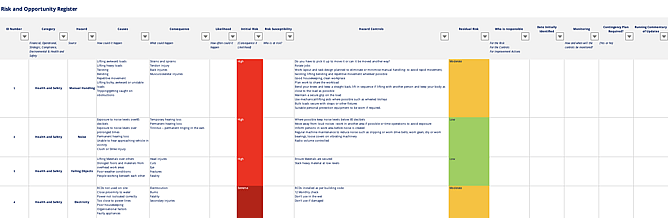
A risk register is a working list of the health and safety risks in your business, how serious each one is, the controls in place, who owns each risk and when it's next reviewed. The Health and Safety at Work Act 2015 (HSWA) doesn't require a risk register by name, however it does require a PCBU to identify and manage its risks so far as is reasonably practicable and a live, owned register is the simplest way to show WorkSafe you're doing that.
When done poorly, it becomes one of the first documents regulators scrutinise after an incident.
What Is a Risk Register?
A risk register is a structured record of workplace health and safety risks and the controls used to manage them.
In a health and safety context, a risk register documents:
identified hazards and sources of harm
risk assessments (likelihood and consequence)
control measures applied using the hierarchy of controls
ownership and accountability for controls
review dates and effectiveness checks
Short answer:
A risk register shows how a business identifies hazards, controls risk and verifies that controls remain effective over time.

Why Managing a Risk Register Matters Under HSWA
Under HSWA, PCBUs must eliminate risks to health and safety so far as is reasonably practicable and minimise them where elimination isn't possible.
A risk register matters because it:
demonstrates systematic risk management
links hazards to controls and accountability
shows how decisions were made and reviewed
provides evidence of due diligence by officers
After serious incidents, WorkSafe often asks one question early:
“Show us how this risk was identified, controlled, and reviewed.”
The risk register is usually where you find that answer and often where you find it missing.
Risk Register vs Risk Assessment: What’s the Difference?
People often mix the two up, however the difference is straightforward.
A risk assessment evaluates a specific hazard or task at a point in time
A risk register tracks risks over time, across the business
Risk assessments feed into the risk register and the register then tracks whether controls remain effective as conditions change.
If your risk register doesn’t change, your risk management probably isn’t working.
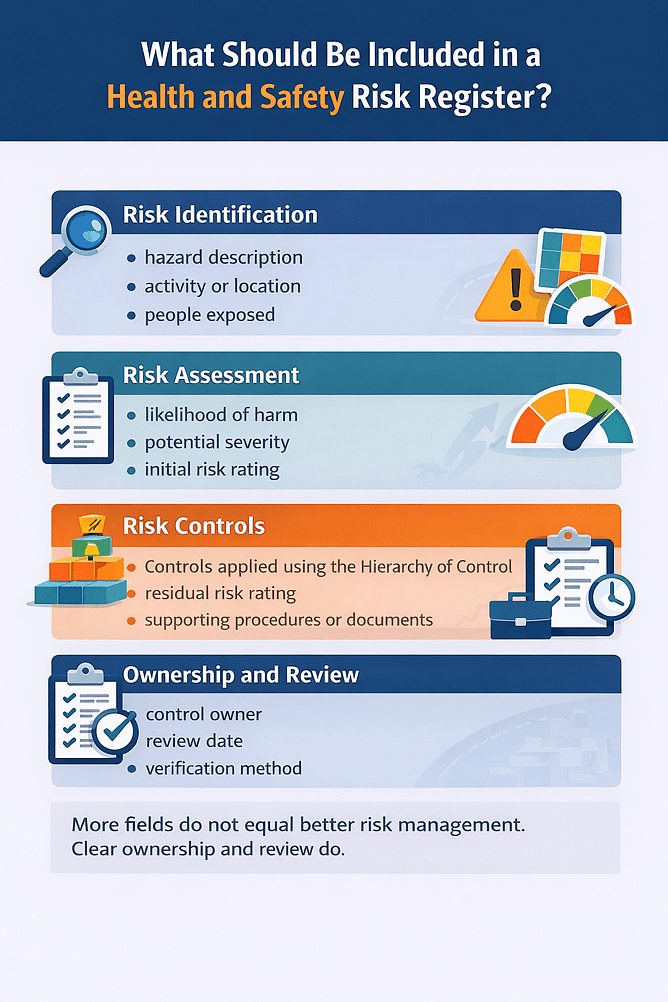
What Should Be Included in a Health and Safety Risk Register?
A practical NZ health and safety risk register typically includes:
Risk Identification
hazard description
activity or location
people exposed
Risk Assessment
likelihood of harm
potential severity
initial risk rating
Risk Controls
controls applied using the Hierarchy of Control
residual risk rating
supporting procedures or documents
Ownership and Review
control owner
review date
verification method
More fields don't mean better risk management. Clear ownership and review do.
How to Create a Risk Register That Actually Works
Step 1: Identify Real Hazards
Use inspections, worker input, incident data and task analysis and don't copy hazards from templates without context.
Step 2: Assess Risk Honestly
Risk ratings should reflect reality, not optimism. Over-downscoring risk is a common failure point in prosecutions.
Step 3: Apply the Hierarchy of Control
Engineering and elimination controls should be prioritised over administrative controls and PPE.
Step 4: Assign Clear Ownership
Every control must have a named owner, shared responsibility usually means no responsibility.
Step 5: Review When Conditions Change
Changes in equipment, layout, people, contractors or work methods should trigger review.
This links directly to management of change, not annual compliance cycles.
Common Risk Register Mistakes I See in NZ Workplaces
treating the register as a static document
listing hazards without linking to controls
relying on administrative controls by default
failing to review after change or incidents
disconnect between register and actual work
Many high-profile NZ prosecutions involve risks that were “known” but not effectively managed.

Risk Registers, Contractors, and Shared Workplaces
In multi-PCBU environments, risk registers must align across organisations.
This means:
identifying overlapping risks
clarifying who controls what
integrating contractor risk into the principal’s system
Contractor risk management failures frequently feature in enforcement action, especially where registers exist but aren't shared or verified.
Real NZ Lessons: Why Risk Registers Matter
KiwiRail and port sector prosecutions have repeatedly reinforced the same message:
change invalidates controls
assumptions aren't risk management
documentation must reflect reality
In many cases risk registers existed, however they were outdated, generic or disconnected from work as actually performed.
How Risk Registers Support Better Safety Outcomes
When managed properly, risk registers:
improve decision-making
focus attention on high-risk work
support leadership oversight
reduce reliance on worker behaviour alone
Risk registers are about preventing harm before it occurs, not compliance theatre.
When a Risk Register Is Drawn on the Wrong Boundary
A risk register can be competent, current and still wrong. When the Moa Point wastewater plant in Wellington failed in February 2026, review chair Raveen Jaduram noted that the risk analysis had covered specific upgrades, not the whole plant as a system.
That's the scoping trap, a competent assessment drawn on the wrong boundary is the most convincing and least tested document in the building. It's one of the cases I use in Raise the Standard.
Before you review the scores in your own risk register, check the boundary. Which sites, assets, contractors and handovers sit outside it? Who decided that?
The free G.A.P.E. Self-Assessment is a quick way to test whether what your register says matches what's actually happening.

Frequently Asked Questions About Risk Registers
Do I legally need a risk register?
HSWA doesn't mandate a specific document, however it requires effective risk management. A risk register is the most common way to demonstrate this.
How often should a risk register be reviewed?
Whenever conditions change, after incidents and at planned intervals, annual review alone usually isn't enough.
What is the difference between a risk register and a hazard register?
They're often used interchangeably, however a risk register should link hazards to risk level, controls, ownership and review, not just list hazards.
Who should be involved in maintaining the risk register?
Workers, supervisors and leaders should all be involved, risk registers built in isolation rarely reflect reality.
Final Thoughts
Managing a risk register isn't about filling in rows of a spreadsheet.
It's about making sure risks are understood, controlled, owned and reviewed as work evolves.
Well-managed risk registers rarely attract attention because the incidents don't happen.
Poorly managed ones are often read aloud in court.
About the Author

Matt Jones is the founder of Advanced Safety and a HASANZ-registered health and safety consultant. He's a Professional Member of NZISM and holds a Graduate Diploma in Occupational Safety and Health.
He created Compliance Compass, the independent audit Advanced Safety uses to show leaders what's actually happening on site against what the documents say. The thinking behind it sits in his book Raise the Standard: Why Good Organisations Go Blind and How Leaders Restore Visibility, built on three frameworks: G.A.P.E.™ finds where visibility is lost, S.A.F.E.T.Y.™ designs the leadership architecture that closes the gap and F.E.E.D.™ keeps it closed.
He also hosts the Health & Safety Unplugged podcast.
Keep reading
Compliance Compass
Does your health and safety system work the way it reads on paper?
Compliance Compass is an independent audit of your health and safety system, delivered in four weeks and assessed against ISO 45001 and the Health and Safety at Work Act 2015. You see what’s really happening on site and in the documents, with a clear view of what to fix first.
If you’re not ready for that yet, start with the free Compliance Compass Self-Check or browse the case studies.
Latest update: 10 November 2026