The Role of Personal Protective Equipment (PPE) in the Workplace:
What You Need to Know
Under New Zealand's Health and Safety at Work Act 2015 (HSWA 2015) and the Health and Safety at Work (General Risk and Workplace Management) Regulations, Personal Protective Equipment (PPE) sits within the hierarchy of controls businesses use to manage workplace risks.
PPE should never be your first line of defence, however it's still an important safety measure when higher-order controls like elimination, substitution or engineering controls can't fully eliminate risk.
The rules on PPE come from HSWA 2015 and its regulations while the practical detail on choosing and using it sits in WorkSafe NZ guidance materials.
The Role of PPE in the Hierarchy of Controls
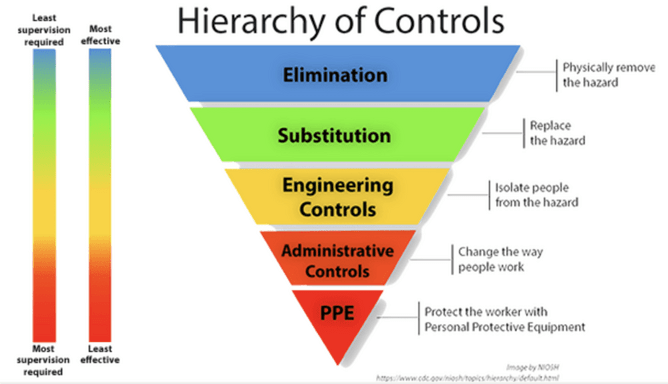
The hierarchy of controls ranks the ways you can manage a risk from most effective to least effective. PPE sits at the bottom as the last line of defence, used only when other measures can't fully control the risk.
The hierarchy includes:
Elimination removes the hazard entirely.
Substitution replaces the hazard with something safer.
Engineering controls isolate people from the hazard.
Administrative controls change the way work is done to reduce exposure.
PPE puts protective gear between the worker and whatever risk is left.
PPE doesn't control a hazard at its source, however it can minimise harm when it's combined with other safety measures.
Legal Requirements for PPE Under HSWA 2015
Under the HSWA 2015, PCBUs (Persons Conducting a Business or Undertaking) have specific duties regarding PPE, including:
Ensuring appropriate PPE is provided to workers free of charge.
Ensuring PPE is fit for purpose, well maintained and meets relevant safety standards.
Providing training and instruction on how to use, store and maintain PPE properly.
Monitoring that PPE is used as required and remains effective.
Workers, in turn, have a responsibility to:
Wear PPE correctly as instructed.
Take reasonable care to maintain their PPE.
Notify their employer if PPE is damaged, defective or inadequate for the task.
Types of PPE and Their Uses
PPE comes in many forms, tailored to specific workplace hazards. Common examples include:
Head Protection: Hard hats protect against falling objects, impacts and head injuries.
Eye and Face Protection: Safety glasses, goggles and face shields protect against dust, debris, chemicals and sparks.
Hearing Protection: Earplugs or earmuffs reduce exposure to hazardous noise levels.
Respiratory Protection: Masks or respirators protect against airborne contaminants like dust, fumes and toxic gases.
Hand Protection: Gloves guard against cuts, abrasions, chemicals and thermal risks.
Body Protection: High-visibility clothing, coveralls or flame-resistant garments protect against visibility risks, spills and extreme conditions.
Foot Protection: Safety boots prevent injuries from heavy objects, punctures and electrical hazards.
WorkSafe NZ provides detailed guidance on selecting PPE that meets recognised AS/NZS standards for protection and performance.
Best Practices for Implementing PPE
To ensure PPE is used effectively, PCBUs should follow these steps:
Conduct a Risk Assessment
Identify workplace hazards and determine where PPE is necessary to minimise risks.Select the Right PPE
Choose PPE that's fit for the task, comfortable and suitable for the individual worker. Ill-fitting PPE can compromise both safety and compliance.Provide Training
Workers must understand when and how to wear PPE, its limitations, and how to care for it.Ensure Proper Fit and Maintenance
PPE needs regular inspection to check it's still in good condition. Anything damaged or worn out must be replaced immediately.Monitor and Enforce Use
Supervisors should check workers are using PPE consistently and deal with anything getting in the way, such as discomfort or a lack of understanding.
Key Considerations from WorkSafe NZ
WorkSafe NZ is clear that PPE should never be a stand-alone solution and should always be used alongside other control measures. Its guidance also makes these points:
Employers must consult workers when selecting PPE to make sure it's suitable and practical.
PPE must account for worker diversity, including fit and usability for all genders, body types, and cultural considerations.
Providing clear signage and reminders can reinforce PPE use in hazardous areas.
Final Thoughts
PPE is an essential part of workplace safety, however it only works as part of a broader approach to managing risk. Under HSWA 2015 and its supporting regulations, PCBUs have a clear responsibility to make sure PPE is provided, fit for purpose and used effectively.
Why PPE Use Drifts Even When the Rules Are Clear
In my book Raise the Standard I spend a lot of time on how drift begins. It almost never starts with somebody deciding to ignore the rules, it starts with a small exception that feels perfectly reasonable at the time, like skipping a spotter just once.
PPE is one of the easiest places for that kind of drift to take hold. Nothing goes wrong the first time the glasses stay in the pocket for a quick job, the second time feels just as reasonable and before long the exception is simply how the work gets done. Adaptation isn't the same as improvement, however the paperwork will still say the PPE is being worn.
If you want to see whether what your PPE rules say matches what actually happens on the floor, the G.A.P.E. Self-Assessment is a free place to start.
Frequently Asked Questions About Personal Protective Equipment (PPE)
Do employers have to pay for PPE in New Zealand?
Yes, a PCBU must provide PPE to workers and can't charge them for it or make bringing their own a condition of employment. A worker can choose to supply their own PPE for comfort or convenience as long as the PCBU is satisfied it's suitable.
Can a worker refuse to wear PPE?
No, workers have their own duty under the regulations to wear or use PPE in line with the information, training and reasonable instruction the PCBU gives them. If someone keeps taking it off it's worth asking why first, WorkSafe's own guidance describes a welder who kept removing his safety glasses until the business found a pair he could wear comfortably.
Where does PPE sit in the hierarchy of controls?
PPE is the last line of defence. Under regulation 6 of the General Risk and Workplace Management Regulations you only rely on it for the risk that's left after elimination, substitution, isolation, engineering and administrative controls have been considered.
About the Author

Matt Jones is the founder of Advanced Safety and a HASANZ-registered health and safety consultant. He's a Professional Member of NZISM and holds a Graduate Diploma in Occupational Safety and Health.
He created Compliance Compass, the independent audit Advanced Safety uses to show leaders what's actually happening on site against what the documents say. The thinking behind it sits in his book Raise the Standard: Why Good Organisations Go Blind and How Leaders Restore Visibility, built on three frameworks: G.A.P.E.™ finds where visibility is lost, S.A.F.E.T.Y.™ designs the leadership architecture that closes the gap and F.E.E.D.™ keeps it closed.
He also hosts the Health & Safety Unplugged podcast.
Keep reading
Compliance Compass
Does your health and safety system work the way it reads on paper?
Compliance Compass is an independent audit of your health and safety system, delivered in four weeks and assessed against ISO 45001 and the Health and Safety at Work Act 2015. You see what’s really happening on site and in the documents, with a clear view of what to fix first.
If you’re not ready for that yet, start with the free Compliance Compass Self-Check or browse the case studies.
Latest update: 5 November 2026