
Risk appetite in health and safety isn’t a slogan about zero harm. It’s a board-level decision about how much exposure the organisation is prepared to carry in pursuit of its objectives and how that sits within legal duty and operational capacity.
Risk tolerance defines the measurable limits within that appetite. When either is misunderstood, governance weakens and exposure increases.
What Is Risk Appetite in Health and Safety?
Risk appetite is the amount and type of risk an organisation is willing to pursue or retain to achieve its strategic objectives. That’s close to the definition in ISO Guide 73, the risk management vocabulary published alongside ISO 31000.
In health and safety this isn’t about accepting harm. It’s about defining the boundaries within which decisions are made under pressure.
A risk appetite statement that works in health and safety should:
Clarify exposure expectations
Align with strategy
Reflect operational reality
Sit within legal duty under HSWA 2015
Without that clarity a risk appetite statement becomes performative, words on a page that nobody uses to make a decision.
Risk Appetite vs Risk Tolerance in Health and Safety
Risk appetite defines the overall boundary and risk tolerance defines the measurable limits within that boundary.
For example, risk appetite may state the organisation won’t accept uncontrolled exposure to fatal risk.
Risk tolerance then defines the measurable conditions under which high-risk work may go ahead, such as:
Permit controls in place
Competency verified
Supervision levels defined
Environmental constraints met
Confusing these terms leads to drift and drift creates exposure.
Discover the difference between hazard and risk here.

The “Zero Harm” Trap
In facilitated workshops boards often default to “zero harm”.
The intent behind zero harm is honourable, however the consequence is often unexamined.
A common version is a board setting risk tolerance to “low” across every known hazard, with no differentiation between categories.
A blanket “low” setting tends to produce:
Unrealistic thresholds
Operational inconsistency
Legal exposure
No prioritisation
Business as usual
Nobody can say what “low” actually means in practice.
Look closely and the organisation usually isn't meeting its own declared standard, there are no clear improvement priorities and resourcing hasn't moved.
Once the distinction between appetite, tolerance and legal duty is clear, resourcing can shift, critical risks get identified and leadership starts pulling in the same direction.
Good intention without risk literacy is dangerous.
When Risk Appetite Overrides Legal Duty
Under HSWA 2015 PCBUs must eliminate risks so far as is reasonably practicable and if elimination isn’t reasonably practicable, they must minimise those risks so far as is reasonably practicable.
A risk appetite statement doesn’t override that duty, yet I’ve seen leaders assume it does:
“If our tolerance is high, we can defer this control.”
That assumption is wrong in law: if a control is available and reasonably practicable it must be implemented regardless of appetite.
When appetite is misused to delay control implementation:
Management becomes disempowered
Controls drift
Exposure increases silently
Risk appetite guides decision-making within legal boundaries, it doesn’t redefine them.
What Happens When Risk Appetite Is Undefined
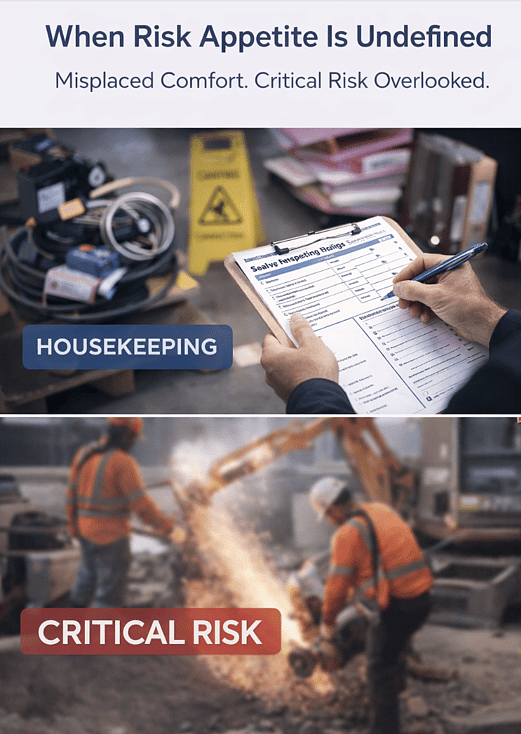
When risk appetite is vague or mis-set:
Resource flows to visible issues not critical exposure
Board reports focus on housekeeping not fatal risk
Practitioners become reactive
Executive confidence increases while actual control weakens
I’ve seen inspection reports filled with findings like:
Test and tag findings
Sign-in breaches
Minor housekeeping issues
Meanwhile the critical risks that can actually kill someone, such as:
Work at height
Driving exposure
Hot works
Excavation
Fatigue
Overlapping PCBU coordination
Those critical risks received far less scrutiny in the same reports.
An undefined risk appetite creates misplaced comfort at board level.
How Risk Appetite Connects to S.A.F.E.T.Y.™
In the S.A.F.E.T.Y. framework, risk appetite lives primarily in:
S: Strategy
A: Accountability
Without strategic clarity, risk appetite becomes reactive.
Without clear accountability, tolerance limits don’t get enforced.
F.E.E.D.™ makes sure reporting feeds back into how appetite is recalibrated.
G.A.P.E.™ ensures leaders remain proximate enough to see whether declared appetite matches operational exposure.
Risk appetite isn’t a document, it’s a governance behaviour.
Developing a Risk Appetite Framework in Health and Safety
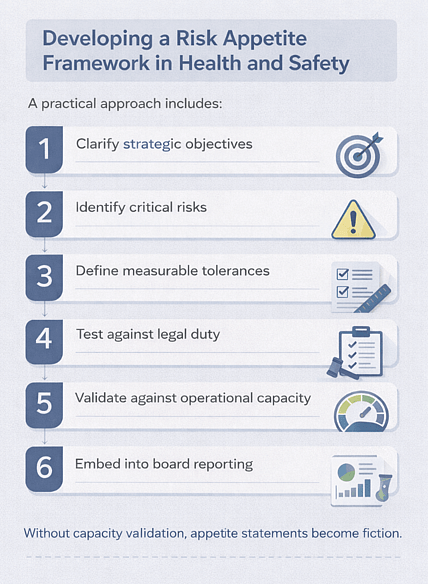
A practical approach to building one includes:
Clarify strategic objectives
Identify critical risks
Define measurable tolerances
Test against legal duty
Validate against operational capacity
Embed into board reporting
Without capacity validation, appetite statements become fiction.
Reporting Risk Appetite Honestly to the Board
Setting a risk appetite only helps if the people reporting against it tell the board the truth. In Raise the Standard I make the case that a practitioner’s job is to neither sanitise the picture nor frighten the board with it. Both distort the decisions the board makes about tolerance.
The honest picture, framed well, is what earns reliance. Showing a board that the control protecting a worker also protects a $100k asset gets a hearing that a list of near misses rarely will. I think of influence as a reserve that you build in the quiet weeks with accurate reporting and spend only on the critical few risks that sit outside tolerance.
If you’re a director or officer wondering whether your board’s view of risk would hold up, the free Officer Due Diligence Check takes you through the questions your due diligence duty under section 44 of HSWA expects you to be able to answer.
Frequently Asked Questions
What is risk appetite in health and safety?
Risk appetite in health and safety is the amount and type of risk an organisation is willing to accept in pursuit of strategic objectives within legal duty boundaries.
What is the difference between risk appetite and risk tolerance?
Risk appetite sets the overall boundary of acceptable exposure. Risk tolerance defines the measurable limits within that boundary for specific risks or activities.
Can risk appetite override HSWA obligations?
Risk appetite can’t override your obligations under HSWA. The duty under HSWA 2015 to eliminate or minimise risk so far as is reasonably practicable applies regardless of declared appetite.
What happens if risk tolerance is set too low?
Unrealistic thresholds create operational inconsistency and legal exposure because the organisation may not meet its own declared standards.
What happens if risk tolerance is set too high?
Controls may be deferred, critical risks under-prioritised and leadership confidence may exceed actual capability.
Executive Diagnostic
Ask each board member these questions privately:
What are our top five safety risks?
What is our tolerance threshold for each?
How do we verify we are operating within tolerance?
If answers vary widely, appetite clarity is insufficient.
The Compliance Compass™ gives you an independent view of your governance and of whether your declared risk appetite matches your exposure on the ground.
Safety isn’t paperwork, it’s leadership under pressure.
About the Author

Matt Jones is the founder of Advanced Safety and a HASANZ-registered health and safety consultant. He's a Professional Member of NZISM and holds a Graduate Diploma in Occupational Safety and Health.
He advises boards, directors and executives on officer due diligence and critical risk under the Health and Safety at Work Act 2015. His book Raise the Standard: Why Good Organisations Go Blind and How Leaders Restore Visibility sets out G.A.P.E.™, F.E.E.D.™ and S.A.F.E.T.Y.™, a leadership architecture framework for high-risk organisations.
He created the Compliance Compass audit and hosts the Health & Safety Unplugged podcast.
Keep reading
Governance Advisory
Is the health and safety report your board reads actually true?
Your officers carry a personal due diligence duty under the Health and Safety at Work Act 2015. Governance Advisory puts an independent view over your critical risk reporting every month and a short paper in front of your board every quarter, giving the people who sign off a true picture of what’s going on.
Start with the free Officer Due Diligence Check or read the Colliers Project Leaders case study.
Latest update: 5 November 2026