Why Safety Systems Fail
Safety systems fail under pressure when documented controls aren't embedded in leadership behaviour, operational practice, worker voice, verification routines and governance oversight.
Most failures aren't caused by missing paperwork, they're caused by a gap between what leaders believe is happening and what's actually occurring on site.
That gap is where health and safety liability lives.
The 6:47am Phone Call

Your phone rings at 6:47am and there's been an incident.
It's nothing catastrophic thankfully, however WorkSafe is on its way.
Suddenly every policy you've signed feels theoretical, every board report feels incomplete and every assurance conversation feels untested.
This is where safety systems are revealed, not during audits, tenders or toolbox talks but under pressure, under scrutiny and under consequence.
Too often this is the moment organisations discover their system performs well on paper but fractures in reality.
Why Safety Systems Fail Under Pressure: Sign One
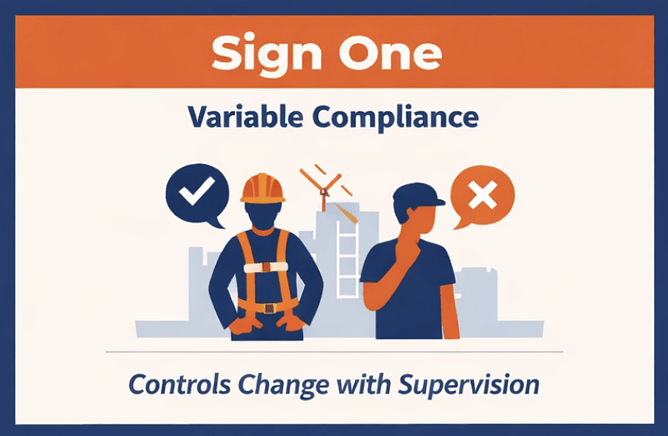
Controls Exist But Implementation Varies
If harness use depends on who is watching, your system is performative.
If permits are followed during audits but streamlined under deadlines, your controls are conditional.
If PPE appears during walkthroughs and disappears during routine operations, your safety culture is observational, not embedded.
This variability signals something deeper than rule-breaking, it signals that leadership hasn't embedded non-negotiable standards.
When WorkSafe looks at your system it's looking at what actually happens on the ground, not at what the business intended.
A system that only works under supervision isn't strong, it's fragile.
Why Safety Systems Fail Under Pressure: Sign Two
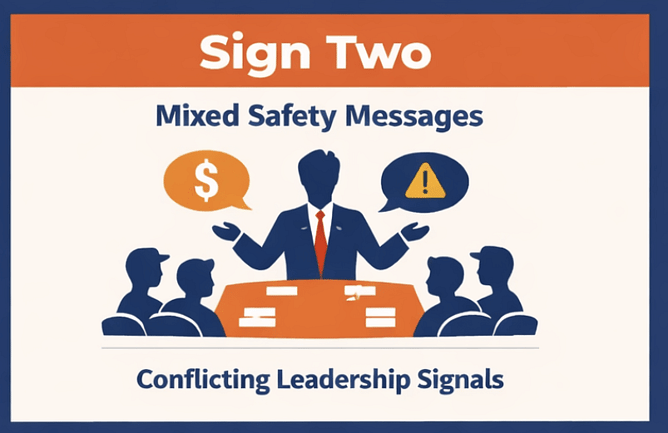
Leadership Sends Mixed Safety Signals
Under HSWA 2015 an officer's duty of due diligence can't be transferred to anyone else.
Yet the most common safety system failure I see begins in subtle leadership contradictions.
A project proceeds before review is complete.
A senior leader refers to “safety bureaucracy” in front of the crew.
Deadlines are celebrated without confirming risk controls were maintained.
Workers are intelligent observers and they quickly understand which commitments are aspirational and which are non-negotiable.
When production consistently outranks protection in behaviour, your safety system has already been deprioritised regardless of what your policy says.
This isn't cultural softness, it's governance drift.
Why Safety Systems Fail Under Pressure: Sign Three
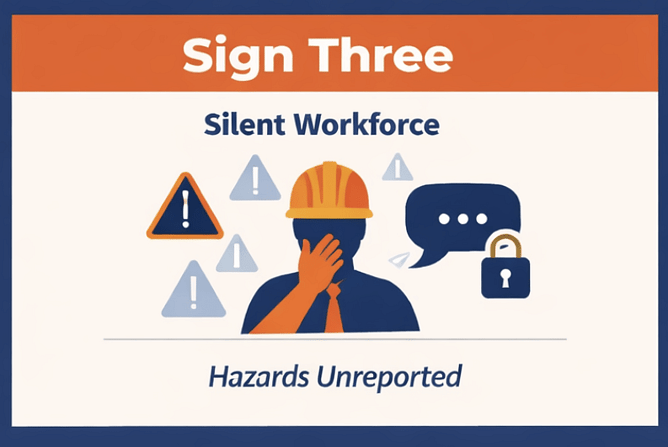
Workers Stay Silent
The most dangerous hazards aren't the ones reported, they're the ones workers decided weren't worth reporting.
Silence starts when workers believe any of these:
Nothing changes
Reporting slows work
Raising concerns damages reputation
Management already “knows”
At that point staying silent becomes the rational choice for a worker.
Under HSWA, worker engagement isn't optional: PCBUs have a duty to engage with workers and to have practices that let them take part in improving health and safety.
Psychological safety can't be created by procedure though. If reporting doesn't produce visible action, reporting dies.
When reporting dies, your board reports become fiction.
Why Safety Systems Fail Under Pressure: Sign Four
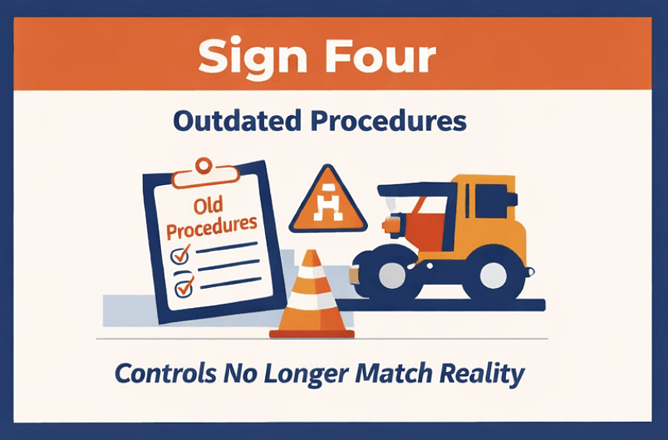
The System Has Drifted From Operational Reality
Safety management systems have expiry dates, even when nobody has written one on the cover.
New equipment, modified workflows, contractor changes and client-driven process shifts mean operational reality evolves faster than documentation.
Unless verification is active and structured, a dangerous divergence develops:
The documented system describes one set of controls while the real operation runs on another.
This is where ISO 45001 certification can create false comfort.
Certification confirms your system met a standard at a point in time, it doesn't guarantee your current controls reflect today's exposure.
Verification has to be deliberate: walk the site, compare procedure to practice, test controls and challenge assumptions.
Without that discipline, your safety management system becomes historical documentation.
Why Safety Systems Fail Under Pressure: Sign Five
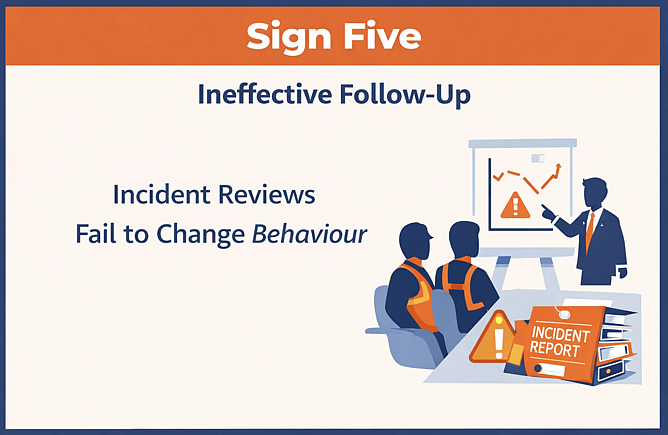
Incident Reviews Don’t Change Behaviour
If the same incidents keep repeating, the learning has failed.
Most investigations identify immediate causes, few interrogate the systemic drivers behind them:
Leadership pressure
Resource constraints
Workflow design
Conflicting KPIs
Cultural normalisation of shortcuts
Retraining alone doesn't fix the structural drivers behind an incident.
When incident reviews focus on paperwork updates instead of systemic correction, the risk remains.
A mature safety system evolves after an incident, while a fragile one simply documents it.
The Governance Gap: Where Director Exposure Lives
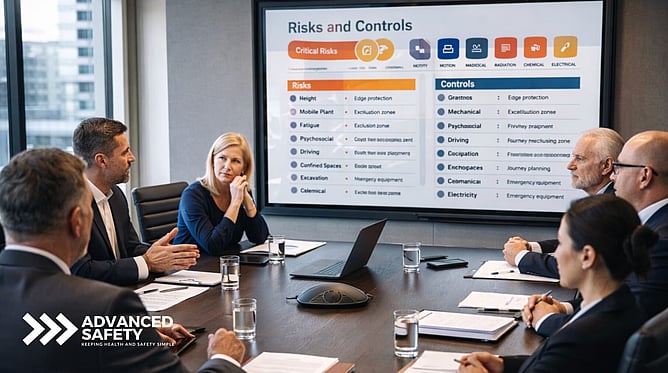
Across all five signs a common pattern emerges: leaders believe the system is stronger than it is.
In most cases this isn't negligence, it's distance from the work.
Board reporting often focuses on activity measures like these:
Lag indicators
Administrative compliance
Training completions
Audit percentages
Meanwhile the questions that actually matter remain unanswered:
What are our critical risks?
Are critical controls verified?
Where are controls degrading?
What behaviours are being normalised?
What are workers not telling us?
This is where officer liability becomes real.
Under section 44 of HSWA 2015, due diligence requires officers to take reasonable steps to:
Acquire and keep up-to-date knowledge of work health and safety matters
Understand operations and associated risks
Ensure appropriate resources and processes
Verify that the resources and processes are provided and used
Verification is the difference between confidence and assumption.
The Safety System Maturity Question
Safety systems tend to sit somewhere across four maturity zones:
Reactive
Systematic
Proactive
Integrated
The problem isn't being in a lower zone, it's believing you're in a higher one.
Most organisations overestimate their maturity because documentation exists.
Maturity isn't measured by paperwork, it's measured by consistency under pressure.
The Cost of Getting This Wrong

The cost of getting this wrong isn't only regulatory, it's strategic.
Tender exclusion
Director prosecution
Reputational damage
Operational shutdown
Insurance implications
Talent attrition
Most significant of all is the loss of trust.
When workers lose trust in the safety system, performance declines.
When regulators lose trust in governance, scrutiny increases.
When boards lose trust in reporting, confidence fractures.
What Strong Governance Looks Like Under Pressure

Strong systems show the same things every time they're tested:
Critical risks clearly defined
Critical controls assigned and owned
Control effectiveness routinely verified
Reporting structured around exposure not activity
Leadership behaviour aligned with stated priorities
Workers confident that raising concerns leads to action
None of this is theoretical maturity, it's observable discipline.
The Question That Matters
If WorkSafe arrived on site tomorrow, could you:
Clearly articulate your top five critical risks?
Explain how each is controlled?
Demonstrate verification routines?
Show evidence of recent challenge?
Identify your weakest maturity pillar?
If not, the system may be more hopeful than resilient.
Safety isn't paperwork, it's leadership under pressure.
Raising Concerns Before Safety Systems Fail
One of the hardest things for a safety professional is telling leaders that the system they're proud of won't hold under pressure. In Raise the Standard I describe a different way to say it. Instead of asking for better compliance, a request that usually gets heard as criticism of the people running the work, you tell the board there's a governance assumption you can't currently verify.
That small change moves the conversation away from operational blame and onto leadership visibility. It's also where every one of the five signs above leads, back to leaders who believe the system is stronger than it is. A director can argue with a criticism of the site, it's much harder to argue with a question about what the board can actually prove.
If you want to test that gap in your own organisation, the free G.A.P.E. Self-Assessment walks you through the four layers: what leaders believe, what the documents say, what people actually do and what can be proven.
Frequently Asked Questions: Why Safety Systems Fail Under Pressure
What causes safety systems to fail under pressure?
Safety systems fail when there's a gap between documented controls and actual operational behaviour.
Most failures aren't due to missing policies, they happen when:
Leadership behaviour contradicts stated priorities
Critical controls are not verified
Workers stop reporting concerns
Governance assumes compliance without evidence
Failure under pressure reveals weaknesses that were already present.
How do I know if my safety system is performative rather than embedded?
A performative safety system shows signs such as:
PPE use changes depending on supervision
Procedures are followed during audits but relaxed during deadlines
Workers comply when observed but improvise when unobserved
Board reports focus on activity instead of exposure
An embedded system works the same way whether anyone is watching or not.
Why do directors face personal risk when safety systems fail?
Under section 44 of the Health and Safety at Work Act 2015, officers have a positive duty of due diligence.
Due diligence means officers must take reasonable steps to:
Acquire and maintain knowledge
Understand operational risks
Ensure appropriate resources
Verify that resources and processes are provided and used
If verification doesn't happen, officers may be exposed even when policies exist.
Liability attaches to governance failure, not just operational mistakes.
What is the difference between compliance and capability in safety management?
Compliance focuses on documentation and meeting minimum legal standards.
Capability is about whether the system actually works and it comes down to:
Control effectiveness
Leadership alignment
Cultural integrity
Continuous improvement
Verification discipline
An organisation can be compliant and still fragile.
Capability determines whether the system performs under pressure.
How often should safety systems be verified against real operations?
Verification should happen at these points as a minimum:
When operational changes occur
When new equipment or contractors are introduced
After incidents
At structured intervals determined by risk profile
Annual review alone isn't enough in high-risk environments.
Verification needs to be ongoing and based on evidence from the work itself.
What are the warning signs that leadership messages are undermining safety?
The common indicators to watch for include:
Safety described as bureaucracy
Deadlines celebrated without confirming control integrity
Resource allocation prioritising production over risk reduction
Senior leaders bypassing procedures
Workers quickly detect misalignment between words and actions.
In the end it's behaviour that sets the real standard.
What should executives focus on to prevent system failure?
Executives who want to prevent system failure should prioritise:
Clear definition of critical risks
Identification and ownership of critical controls
Routine verification of control effectiveness
Honest board reporting
Psychological safety for worker voice
Prevention is driven by leadership clarity, not administrative volume.
Executive Call to Action
If you're a director, executive or senior leader responsible for governance, don't wait for the 6:47am phone call to discover your actual exposure.
The Compliance Compass™ provides an independent maturity assessment across:
Governance and officer due diligence
Critical risk and control verification
Operational system alignment
Culture and reporting effectiveness
Safety systems don't fail during calm periods, they fail when they're tested.
About the Author

Matt Jones is the founder of Advanced Safety and a HASANZ-registered health and safety consultant. He's a Professional Member of NZISM and holds a Graduate Diploma in Occupational Safety and Health.
He created Compliance Compass, the independent audit Advanced Safety uses to show leaders what's actually happening on site against what the documents say. The thinking behind it sits in his book Raise the Standard: Why Good Organisations Go Blind and How Leaders Restore Visibility, built on three frameworks: G.A.P.E.™ finds where visibility is lost, S.A.F.E.T.Y.™ designs the leadership architecture that closes the gap and F.E.E.D.™ keeps it closed.
He also hosts the Health & Safety Unplugged podcast.
Keep reading
Compliance Compass
Does your health and safety system work the way it reads on paper?
Compliance Compass is an independent audit of your health and safety system, delivered in four weeks and assessed against ISO 45001 and the Health and Safety at Work Act 2015. You see what’s really happening on site and in the documents, with a clear view of what to fix first.
If you’re not ready for that yet, start with the free Compliance Compass Self-Check or browse the case studies.
Latest update: 5 November 2026