Inclusive communication is one of the most under-used safety tools a business has. Neurodivergent people are commonly estimated to make up around 15 to 20 percent of the population and plenty of adults find dense written material hard going. Clear safety messaging isn't a nice to have, it's how people stay safe.
Why Inclusive Communication Matters
Neurodiversity includes ADHD, autism, dyslexia and more.
Many people won't speak up when they don't understand, especially in a group or under pressure.
Misunderstandings in health and safety communication can lead to real-world harm.

Most people won't say they didn't understand. They'll nod and then do it their own way.
None of this is about being politically correct or overly accommodating. It's about writing safety messages that work for everyone, whatever their learning style, literacy or cultural background.
When communication is clear people can follow it. When it's confusing they fill in the blanks themselves and under time pressure or stress those blanks become hazards.
We often assume policies, forms and systems are enough, however if the person doing the work can't understand what's being asked the best system in the world won't deliver.
Clear communication stops incidents before they happen.
Inclusive communication tips for safer workplaces - Tip 1: Ditch the Jargon
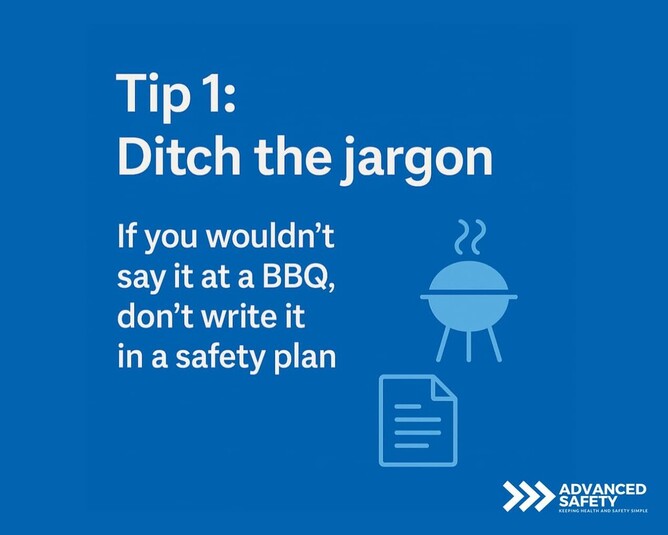
When we talk about workplace safety it's easy to slip into jargon. Terms like "operational oversight", "site-specific risk register" or "administrative controls" are second nature to us, however to the person on the floor they can sound like another language.
If someone doesn't understand you it doesn't matter how correct or compliant the message is.
Use everyday words: swap "implement" for "use" and "facilitate" for "help". Explain it the way you'd explain it to someone at a barbecue.
Translation matters too, into other languages where your team needs it and into terms that make sense to each part of the business. What's obvious to a manager can confuse a temp on their first day.
The goal isn't to sound clever, it's to be understood. That's where safety starts.
Inclusive communication tips for safer workplaces - Tip 2: Use Short Sentences

Long-winded explanations slow people down and cause confusion, especially in high-risk or time-sensitive work.
Short sentences cut the mental load and make it easier for everyone to follow along, with one sentence for one idea as a good rule of thumb. That helps anyone with ADHD, dyslexia or cognitive fatigue who finds dense paragraphs hard to process while following steps.
Break text up with white space and bullet points and put the most important message first.
Before: "All operators must ensure that prior to the commencement of work on any machinery, a pre-start safety checklist has been completed in accordance with the documented process located within the compliance binder."
After: "Complete the pre-start checklist before using any machine. The checklist is in the compliance binder."
You're not removing detail, you're removing noise.
Inclusive communication tips for safer workplaces - Tip 3: Add Visuals
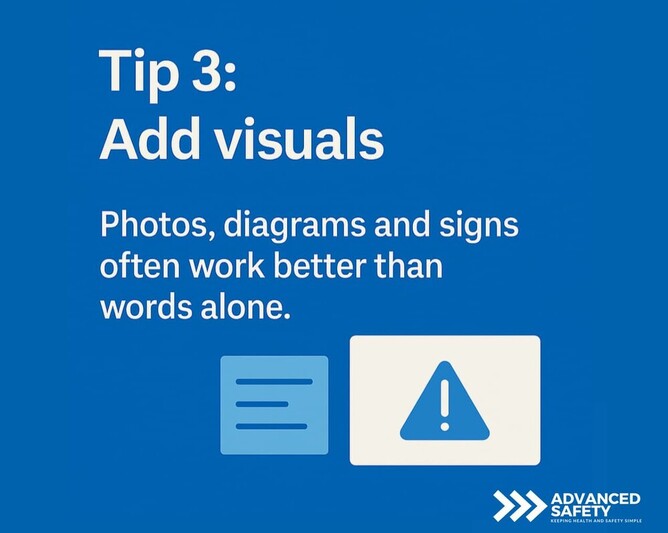
Visuals aren't decoration, they're working tools that help people take in and remember information.
For people who process information differently, images can make clear what words leave fuzzy. Use icons, diagrams, step-by-step illustrations or short videos.
A picture of correct PPE usage beats a paragraph describing it and a labelled diagram of a machine's emergency stop is far more useful than a line of text.
Visuals also work across literacy levels and first languages. WorkSafe's guidance on training suggests pictures, demonstrations and spoken instruction for workers who find reading difficult.
In your training materials, SOPs, site signage and digital forms, ask yourself what you could show instead of explain.
Inclusive communication tips for safer workplaces - Tip 4: Check for Understanding
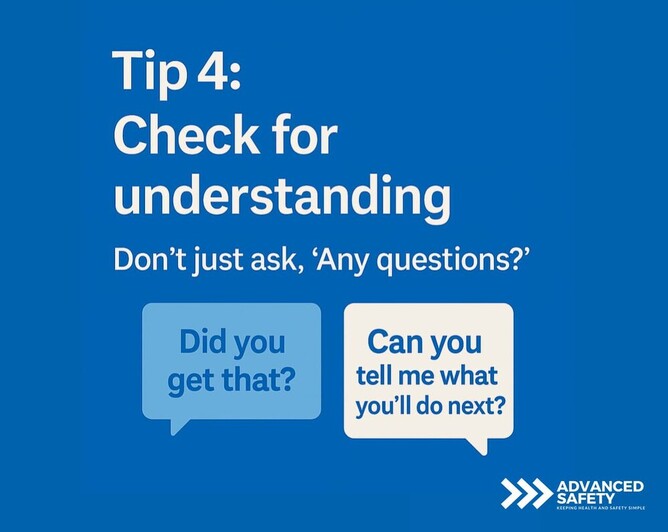
The most common question at the end of a briefing is "Any questions?" and the most common answer is silence.
Silence doesn't mean people have understood you. It can mean confusion, embarrassment or fatigue.
Inclusive communication means confirming people have understood instead of hoping they have.
One method is teach-back, where you ask people to explain the key points in their own words and simplify the message if they can't. Scenario questions do a similar job, since "What would you do if the guard was missing?" tells you far more than "Did you get that?"
A routine where questions are expected helps neurodivergent workers who struggle with unstructured instructions and makes it easier for everyone. Check for understanding to lift people up, not to catch them out.
Let’s Make Your Communication Work Smarter
This isn't about redoing all your systems or paying someone to rewrite everything. Start with one change such as a rewritten bulletin, a simplified SOP or a visual checklist and build from there.
Ditching jargon, shortening sentences, adding visuals and checking for understanding are simple to put in place and they make a real difference to how safely people work.
Inclusive Communication Starts With the People Doing the Work
In Raise the Standard I describe F.E.E.D., the engine that keeps a safety system learning. The first E is Engagement: co-design, with the frontline helping to build the system instead of having it done to them.
Inclusive communication is a co-design job as much as a writing job. Before a new procedure, sign or toolbox talk goes out, sit down with two or three of the people who'll use it, including someone new and someone whose first language isn't English. Ask them to tell you what it means in their own words.
Where they stumble is where the jargon is. Fix it there and the message becomes clear for everyone, not just the people who'd have understood it anyway.
The free G.A.P.E. Self-Assessment helps you test the gap between what your documents say and what people actually do. That gap is often where communication has broken down.
Frequently Asked Questions About Inclusive Communication
What is inclusive communication in health and safety?
Inclusive communication means writing and delivering safety information so everyone can understand it and act on it, whatever their literacy, first language, learning style or neurodiversity. In practice that means plain words, short sentences, visuals and checking people have understood.
Does WorkSafe say safety training has to be easy to understand?
WorkSafe's guidance is that information, training and instruction must be readily understandable by any person it's provided to. It says to consider workers' age, experience, first language, cultural differences and level of understanding. Workers who find reading difficult may need spoken instruction, pictures, demonstrations or a buddy.
How do you check workers have understood safety instructions?
Ask them to explain the key points back in their own words or ask what they'd do in a specific scenario. WorkSafe notes that workers can show understanding and competence through written, verbal or practical tests or through observation. A room that stays silent after "Any questions?" hasn't necessarily understood anything.
About the Author

Matt Jones is the founder of Advanced Safety and a HASANZ-registered health and safety consultant. He's a Professional Member of NZISM and holds a Graduate Diploma in Occupational Safety and Health.
He created Compliance Compass, the independent audit Advanced Safety uses to show leaders what's actually happening on site against what the documents say. The thinking behind it sits in his book Raise the Standard: Why Good Organisations Go Blind and How Leaders Restore Visibility, built on three frameworks: G.A.P.E.™ finds where visibility is lost, S.A.F.E.T.Y.™ designs the leadership architecture that closes the gap and F.E.E.D.™ keeps it closed.
He also hosts the Health & Safety Unplugged podcast.
Keep reading
Compliance Compass
Does your health and safety system work the way it reads on paper?
Compliance Compass is an independent audit of your health and safety system, delivered in four weeks and assessed against ISO 45001 and the Health and Safety at Work Act 2015. You see what’s really happening on site and in the documents, with a clear view of what to fix first.
If you’re not ready for that yet, start with the free Compliance Compass Self-Check or browse the case studies.
Latest update: 5 November 2026