Management of Change (MOC) in Health and Safety: What NZ Businesses Need to Get Right
Management of change (MOC) is one of the most misunderstood and most frequently missed health and safety obligations in New Zealand workplaces.
It's also a recurring theme in serious incidents, prosecutions and regulatory investigations, not because organisations ignore safety entirely but because change quietly invalidates existing controls.
What Is Management of Change (MOC)?
Management of change is the structured process used to identify, assess, and control health and safety risks introduced when something changes at work.
In a New Zealand context MOC isn't a standalone legal term, however it's clearly required by HSWA. PCBUs must ensure risks are managed so far as is reasonably practicable, a duty that applies before, during and after change.
Change can invalidate existing risk assessments, procedures, training and emergency plans. MOC exists to stop organisations assuming that “what worked before” will still work after conditions shift.
Short answer: Management of change is the process of reassessing risk whenever work conditions, systems, people or environments change to make sure controls remain effective.

Why Managing Change Matters for Health and Safety
Most serious incidents don't happen during unfamiliar work, they happen when:
equipment is upgraded or modified
layouts or access points change
work methods evolve incrementally
responsibilities shift between roles or contractors
assumptions go unchallenged
Without MOC, these changes create hidden risk.
Under HSWA, failing to reassess risk during change can expose PCBUs and officers to enforcement action, even where existing systems appear compliant on paper.
Legal Responsibilities Under HSWA During Change
HSWA doesn't use the term “management of change”, however the requirement is embedded throughout the Act.
PCBUs must:
identify new or changed hazards
assess risks arising from change
consult with affected workers
implement effective controls
verify that controls work in practice
Officers must exercise due diligence and that includes making sure systems remain appropriate when conditions change.
Key point: if a change introduces new risk and it wasn't reassessed, the organisation is exposed.

Types of Changes That Require MOC
Physical Changes
new or modified plant and equipment
altered layouts, access ways or work heights
new substances, materials or structures
Operational Changes
new or revised procedures
changes to maintenance or isolation practices
introduction of new technology or software
People and Organisational Changes
new workers or contractors
role changes or restructures
reduced supervision or experience
If the change affects how work is done, MOC should be triggered.
Best Practice: How to Manage Change Safely
Step 1: Define the Change
Clearly describe what's changing, why and who will be affected, vague descriptions lead to missed risks.
Step 2: Reassess Risk
Review hazards against current conditions, not historical assumptions. Consider how people, equipment, the environment and tasks interact.
Step 3: Apply the Hierarchy of Controls
Eliminate or engineer out risk where you can and don't default to administrative controls or PPE.
Step 4: Consult and Communicate
Consulting workers is a legal requirement and the people doing the work often spot risks missed at the planning stage.
Step 5: Verify and Review
Confirm controls are implemented and effective, then review them again if conditions change further.
The Role of Leadership in Management of Change
Leadership failures in MOC are rarely intentional, more often they involve:
assuming minor changes are low risk
delegating risk assessment without oversight
failing to verify that controls still work
Effective leaders ensure that change triggers deliberate pause and reassessment, not rushed implementation.
How ISO 45001 Supports Management of Change
ISO 45001 explicitly requires organisations to manage change in a controlled manner.
Key elements include:
risk-based planning
worker participation
continual improvement
documented verification
For organisations aligned to ISO 45001, MOC should already be embedded in system design.
Common Challenges With MOC - And How to Avoid Them
Change fatigue: treat MOC as proportional, not bureaucratic.
Missed incremental change: review systems periodically, not only during major projects.
Paper compliance: verify controls through observation, not documentation alone.
Frequently Asked Questions About Management of Change
What do you mean by management of change?
Management of change is the process of reassessing health and safety risks whenever work conditions, systems, people or environments change.
What is MOC with an example?
If new equipment is installed, MOC requires reassessing hazards, updating procedures, retraining workers and verifying controls before use.
What is the difference between change management and management of change?
Change management focuses on people and performance, management of change focuses on the risk and safety impacts of change.
What are the 5 principles of management of change?
Identify the change
Assess risk
Apply controls
Consult workers
Verify effectiveness
Why MOC Failures Lead to Serious Incidents
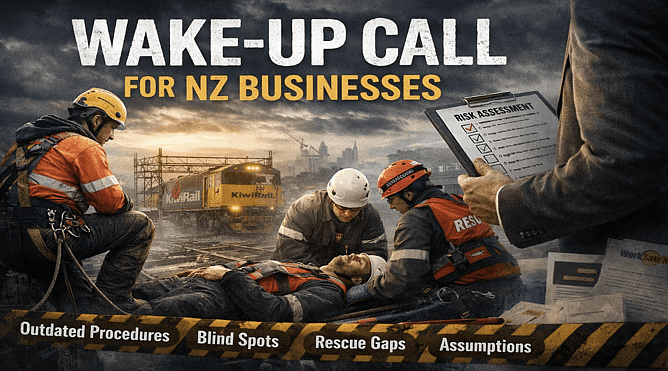
Most prosecutions linked to change involve:
outdated procedures
untested assumptions
controls that no longer match reality
Management of change exists so these lessons aren't learned after someone is harmed.
Recent New Zealand enforcement cases show these questions are not theoretical.
In the KiwiRail prosecution, WorkSafe made it clear that introducing new infrastructure without reassessing task-specific risk exposed workers to serious harm. The issue wasn't reckless behaviour, it was the assumption that existing controls still applied.
Similar patterns have emerged in New Zealand port operations, where changes to plant, traffic management and contractor interfaces have led to enforcement action when risk assessments and controls weren't revisited.
In both settings the regulator’s focus wasn't on documentation volume, it was on whether risk had been actively reconsidered as conditions changed.
Management of Change and the Illusion of Stability
Some of the riskiest change never goes through a management of change process because nobody calls it change. Stable statistics breed confidence, confidence reduces vigilance and small shortcuts start to feel like optimisation. In my book Raise the Standard I call this drift.
The answer is structure that doesn't rely on anyone noticing the change. Name the executive who owns each critical risk, define what an effective control looks like, set how often it gets verified and send evidence to governance instead of reassurance. When a change touches one of those controls, your MOC process has something real to test against.
The free G.A.P.E. Self-Assessment helps you find where change may already have opened a gap between your system and the work.
Final Thoughts
Management of change is about keeping systems aligned with reality and it doesn't need to slow work down.
Organisations that manage change well rarely do more paperwork, they ask better questions at the right time.
About the Author

Matt Jones is the founder of Advanced Safety and a HASANZ-registered health and safety consultant. He's a Professional Member of NZISM and holds a Graduate Diploma in Occupational Safety and Health.
He created Compliance Compass, the independent audit Advanced Safety uses to show leaders what's actually happening on site against what the documents say. The thinking behind it sits in his book Raise the Standard: Why Good Organisations Go Blind and How Leaders Restore Visibility, built on three frameworks: G.A.P.E.™ finds where visibility is lost, S.A.F.E.T.Y.™ designs the leadership architecture that closes the gap and F.E.E.D.™ keeps it closed.
He also hosts the Health & Safety Unplugged podcast.
Keep reading
Compliance Compass
Does your health and safety system work the way it reads on paper?
Compliance Compass is an independent audit of your health and safety system, delivered in four weeks and assessed against ISO 45001 and the Health and Safety at Work Act 2015. You see what’s really happening on site and in the documents, with a clear view of what to fix first.
If you’re not ready for that yet, start with the free Compliance Compass Self-Check or browse the case studies.
Latest update: 5 November 2026