
Safe Work Method Statements (SWMS) in New Zealand – What the Law Actually Requires
Safe Work Method Statements (SWMS) aren't explicitly required by law in New Zealand, however the outcomes they're often used to achieve absolutely are.
Under the Health and Safety at Work Act 2015 (HSWA) and supporting regulations, PCBUs must identify risks, put controls in place using the hierarchy of controls and make sure workers understand how work is to be done safely.
A SWMS can be one way of meeting those obligations, however it's not a legal substitute for proper risk management and it isn't mandated in the same way as in Australia.
Getting this distinction wrong is where many businesses get into trouble.
Are SWMS a Legal Requirement in New Zealand?
No, SWMS aren't specifically mandated under HSWA or its regulations.
However, PCBUs must:
Identify reasonably foreseeable risks
Eliminate risks where practicable
Minimise remaining risks using effective controls
Ensure workers understand how to carry out work safely
Review controls when conditions change
WorkSafe guidance makes it clear that documents aren't the goal, effective risk management is.
SWMS may be used as an administrative tool to support these duties, particularly for complex or high-risk work, however relying on a SWMS alone doesn't meet legal obligations.
What Does A SWMS Look Like?
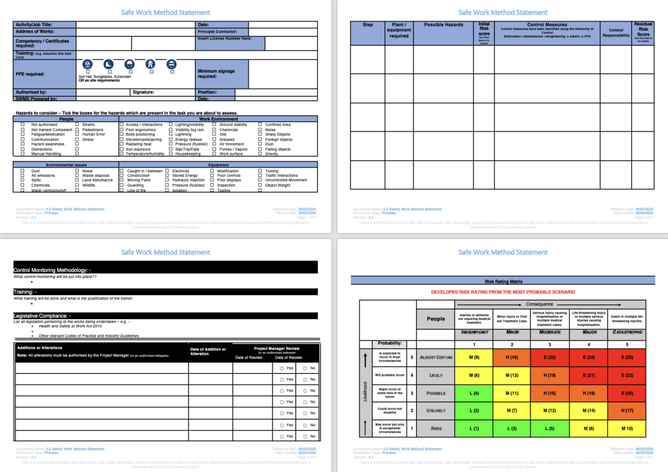
What Is a Safe Work Method Statement (SWMS)?
A Safe Work Method Statement (SWMS) is a task-based document that typically:
Describes a specific work activity
Identifies hazards associated with that task
Outlines control measures to manage those risks
Communicates how work should be carried out safely
In New Zealand, SWMS are most commonly used in construction and infrastructure work, particularly where contractors are familiar with Australian systems or client-driven requirements.
A SWMS is classified as an administrative control under the hierarchy of controls, it doesn't replace higher-order controls such as elimination, isolation or engineering.
Why SWMS Are Commonly Used for High-Risk Work
SWMS aren't legally required, however they're often used to support work involving:
Working at height
Excavations and trenches
Powered mobile plant
Confined spaces
Work near live services or traffic
Complex sequencing or contractor interfaces
In these situations, a SWMS can help communicate risk controls clearly, particularly where multiple parties are involved.
That said, WorkSafe doesn't recognise SWMS as a standalone compliance document.
SWMS vs NZ Legal Requirements – The Critical Difference
This is where many businesses get it wrong.
Under NZ law, PCBUs must ensure:
Risks are assessed in context
Controls are selected using the hierarchy of controls
Workers are trained and given supervision
Controls are monitored and reviewed
WorkSafe guidance emphasises that generic or templated SWMS are often ineffective, especially when:
Site conditions change
Work methods vary
Infrastructure is modified
New hazards are introduced
If a SWMS exists but doesn't reflect how work is actually done, it offers little protection during an investigation.
What WorkSafe Expects Instead of “Just a SWMS”
What WorkSafe Expects Instead of “Just a SWMS”
WorkSafe NZ guidance aligns risk management with:
Task-specific risk assessment
Practical control selection
Worker engagement
Ongoing review
In practice, this often looks like:
A task risk assessment (TRA/JSA/TA)
Site-specific control planning
Clear work instructions
Toolbox discussions
Supervisor verification
Review when conditions change
A SWMS may form part of this system, however it isn't the system itself.
Key Elements of an Effective SWMS (If You Use One)
If your organisation chooses to use SWMS, WorkSafe-aligned best practice includes:
Clear description of the specific task
Hazards linked to the actual site and conditions
Controls prioritised using the hierarchy of controls
Defined responsibilities for implementation
Evidence that workers understand the controls
Review triggers when work conditions change
Overly detailed, generic or “tick-box” SWMS often create false confidence instead of real safety.
Who Should Be Involved in Preparing a SWMS?

An effective SWMS should never be written in isolation.
Best practice involves:
The PCBU responsible for the work
Workers performing the task
Supervisors overseeing the activity
Health and Safety Representatives (where applicable)
Worker involvement is particularly important, not as consultation theatre but to make sure controls are practical and workable.
Implementing a SWMS Properly
A SWMS only adds value if it's actively used.
That means:
Workers understand it before work starts
Supervisors verify controls are in place
Conditions are checked continuously
Work stops if controls are no longer effective
The document is reviewed when circumstances change
A SWMS sitting in a folder or prequal portal offers no legal protection.
Can a Generic SWMS Be Used?
Only as a starting point, never as the final control.
Generic SWMS often fail because they:
Miss site-specific hazards
Assume conditions that don’t exist
Over-rely on PPE
Ignore sequencing or interfaces
WorkSafe has repeatedly highlighted that generic documents don't meet the “reasonably practicable” test if risks are foreseeable.
When a SWMS Looks Perfect on Paper
A SWMS can pass every file review and still protect no one. Documents are static and risk isn't. The moment the job changes, the weather turns or a different crew turns up, the statement in the folder starts describing work that no longer exists.
In Raise the Standard I describe this as the gap between Assumptions and Practice in the G.A.P.E. framework, what the documents say against what people actually do. When paperwork becomes the measure of control, systems get tuned for audit readiness instead of reliability. Assurance without verification is only belief.
The question worth asking on your own site is a simple one: when did a crew last change a SWMS because the job changed? If nobody can remember, the document is describing the plan and not the work.
If you want to see how far your documents and your sites have drifted apart, the free Compliance Compass Self-Check is a good place to start.
Frequently Asked Questions About SWMS
What does SWMS stand for?
SWMS stands for Safe Work Method Statement. It's a document that sets out the steps of a higher-risk task, the hazards at each step and the controls that will manage them.
Is a SWMS a legal requirement in New Zealand?
No, a SWMS isn't specifically required under HSWA or its regulations. What the law does require is that you identify risks, control them using the hierarchy of controls and make sure workers understand how the work will be done safely. A SWMS is one way of showing you've done that.
What's the difference between a JSA and a SWMS?
A JSA assesses a specific task and its risks on the day, while a SWMS sets out how a higher-risk task will be done step by step. Neither replaces a proper risk assessment or higher-order controls. The guide to JSA vs SWMS covers when to use each.
Final Word on SWMS in New Zealand
Safe Work Method Statements aren't legally required in New Zealand, however effective risk management absolutely is.
A SWMS can support that process when:
It reflects real work
It prioritises higher-order controls
It's actively implemented and reviewed
No document will compensate for:
Poor risk assessment
Outdated controls
Unchecked assumptions
Lack of supervision
About the Author

Matt Jones is the founder of Advanced Safety and a HASANZ-registered health and safety consultant. He's a Professional Member of NZISM and holds a Graduate Diploma in Occupational Safety and Health.
He created Compliance Compass, the independent audit Advanced Safety uses to show leaders what's actually happening on site against what the documents say. The thinking behind it sits in his book Raise the Standard: Why Good Organisations Go Blind and How Leaders Restore Visibility, built on three frameworks: G.A.P.E.™ finds where visibility is lost, S.A.F.E.T.Y.™ designs the leadership architecture that closes the gap and F.E.E.D.™ keeps it closed.
He also hosts the Health & Safety Unplugged podcast.
Keep reading
Compliance Compass
Does your health and safety system work the way it reads on paper?
Compliance Compass is an independent audit of your health and safety system, delivered in four weeks and assessed against ISO 45001 and the Health and Safety at Work Act 2015. You see what’s really happening on site and in the documents, with a clear view of what to fix first.
If you’re not ready for that yet, start with the free Compliance Compass Self-Check or browse the case studies.
Latest update: 4 November 2026