Safety training is often presented as checklists, rules or tidy models, yet the most meaningful lessons come from practitioners who have lived through emergencies, trained thousands and seen firsthand how people behave under pressure. In my Health and Safety Unplugged podcast interview, Keith Barnett of Vertical Horizonz shared the safety lessons shaped by seventeen years of real-world experience across working at heights, confined spaces and complex training environments in New Zealand and overseas.
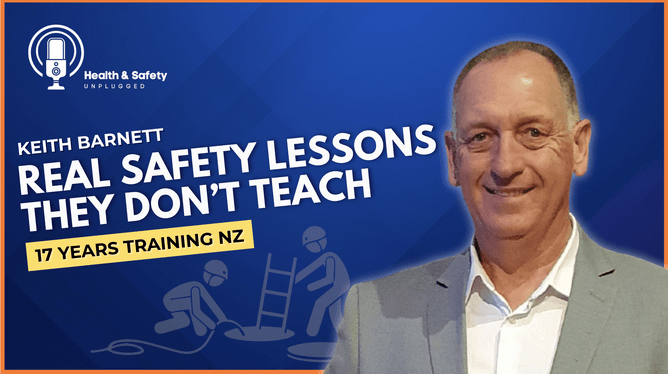
The essential safety lessons are to hold high standards, plan for the worst, make sure communication is clear and shared, understand your people, prepare an exit strategy before entering any hazardous environment and never treat training as a tick-box exercise.
Safety Lessons That Come Before Any Textbook
Safety training tends to be taught in tidy modules, however real safety is rarely tidy. Keith's early experiences in military logistics showed him that safety begins before any formal training course. In environments where risk is constant, the first and most enduring safety lessons revolve around discipline, consistency and situational awareness.
What is the first safety lesson most practitioners miss?
The first safety lesson many miss is that standards are non-negotiable. What you walk past becomes what you accept and that principle shapes every decision a team makes.
Textbooks can teach you the rules but it takes experience to teach you the consequences.
Why Standards Matter in Safety Training
If there's one message Keith emphasised again and again, it's this: The standard you walk past is the standard you accept.
He learned this in the military, however it applies just as much across New Zealand workplaces. Lower your standards once and you reset the benchmark for everyone around you.
For trainers, leaders and auditors this isn't an abstract idea. It plays out every day on worksites, in offices and in training rooms. The safety lesson here is simple: You cannot expect others to rise to a standard you are unwilling to hold yourself. It's a theme I come back to in my own health and safety leadership workshops for managers and team leaders.

Safety Lessons from Military Logistics to New Zealand Workplaces
Keith's pathway into health and safety is unconventional and deeply instructive. His early experiences in the British Army involved weapons, heat, heavy transport and high-pressure operations. Yet it wasn't the military structure that shaped his safety philosophy so much as two incidents:
A collapse from heat exhaustion, where the emergency response was inadequate.
The death of a young soldier under similar conditions, where lessons had not been applied.
These moments forged a lifelong commitment to understanding why things go wrong and how to prevent repeat failures. In his words:
“There has to be better outcomes when something goes wrong.”
This is a safety lesson that should be embedded into every training programme in New Zealand.
The Most Overlooked Safety Lesson – Planning for the Worst
Keith's strongest message was that teams need to embrace the “doomsday thinker”, the person who looks at a plan and asks “What if?”
That question isn't there to be negative or difficult, it's there to expose blind spots before a real emergency finds them for you.
Communication – The Safety Lesson That Holds Everything Together
Keith highlights a principle that every PCBU and safety practitioner needs to pause and reflect on:
Information is useless unless it is shared.
It has to be timely, accessible and understood by the people who need it.
Poor communication is rarely a single-point failure. It becomes a chain:
Assumptions
Missing context
Untested plans
Confusion under pressure
This is a safety lesson many organisations relearn the hard way.
Great communication doesn't mean more paperwork, it means the right information at the right time, shared in the right way.
Practical Safety Training for Working at Heights and Confined Spaces
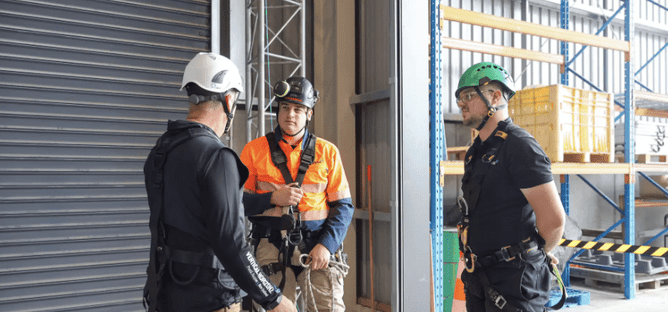
Training for any hazardous environment reveals the same pattern:
people want to do the job, not plan it.
Keith explains that the most valuable lessons for workers are often the ones that feel inconvenient:
Test your equipment before you arrive.
Know your anchor points.
Pre-plan your descent or rescue.
Understand how your body will behave under pressure.
Never assume a space is safe because it was safe yesterday.
The safety lesson here is consistency: skill helps and equipment helps, however habits are what save lives.
Safety Training Lessons for Trainers, Leaders and New Practitioners
New health and safety practitioners often lean heavily on manuals and procedures. Keith understands why: it feels safer, more predictable and more defensible.
He also warns of the trap:
textbook thinking can make practitioners rigid when they need to be adaptable.
Leaders and trainers need to learn how to:
Adjust on the fly
Challenge assumptions
Manage different learning styles
Read people
Ask deeper questions
Create psychological safety in the room
The safety lesson is that great trainers deliver clarity as well as content.
Safety Lessons That Shape People, Not Just Systems

Keith’s advice for 2025 is simple: invest in people.
Training should not be chosen based on budget or compliance pressure alone. Instead, ask:
What value will this training add to the individual?
How will it uplift the organisation?
What capability does it unlock?
What future risk does it prevent?
The worst-case question he hears from PCBUs is: “I've trained this HSR, now what do I do with them?”
Training isn't a cost centre, it's an asset that compounds if you know how to use it.
The Future of Safety Lessons in NZ Training
Health and safety in New Zealand is shifting, expectations are tightening and competency is now a strategic asset.
Organisations can't rely on legacy practices or assumptions any more.
The next generation of trainers will need:
Better preparation
Better planning
Better people skills
Better feedback loops
Better adaptability
The safety lesson for the future is that technical knowledge alone is no longer enough.
Influence matters, engagement matters and cultural leadership matters just as much as legislation.
Final Safety Lessons – Keith Barnett’s Advice for 2026 and Beyond
To close our discussion, Keith offered three recommendations for every practitioner, trainer and leader:
1. Prepare properly.
Know your audience, know your objective and know your plan.
2. Hold your standards.
Never lower them because others do. People follow what you tolerate.
3. Stay open-minded and multiskilled.
The industry rewards adaptability. The safest practitioners are the ones who can shift perspective.
These safety lessons aren't theoretical, they've been lived, taught, tested and strengthened over nearly two decades of real experience.
Watch on Health and Safety Unplugged
If you want to hear these insights in Keith Barnett’s own words, you can watch the full interview in Episode 1 of Season 5 of Health & Safety Unplugged.
This season is designed to bring real, practical knowledge to practitioners across New Zealand and these safety lessons set the tone for what's ahead. Watch on YouTube or Spotify.
What Safety Training Can't Teach You About Influence
Keith's point that influence and engagement now matter as much as technical knowledge is one I spend a whole chapter on in Raise the Standard. One line from that chapter sums up the argument: influence begins with what you refuse to own.
I've watched capable safety people take on drug testing, discipline or psychosocial risk because nobody else would, then wonder why workers stopped confiding in them. You can't be the person people trust with a near miss and the person who decides their consequences. In the book I argue that psychosocial risk sits better with the People function so the safety role keeps the trust it'll need later.
For trainers that trust starts in the room. The person who feels safe enough to admit they don't understand a rescue plan during the course is the same person who'll report the near miss on site.
To see where trust and influence sit in your own practice, work through the free S.A.F.E.T.Y. Leadership Worksheet. It takes you through all six elements of the framework in the book, Trust included. It also shows you which ones need the most work.
Frequently Asked Questions About Safety Training
Is safety training a legal requirement in New Zealand?
Yes, so far as is reasonably practicable a PCBU must provide the information, training, instruction or supervision needed to protect people from risks arising from the work. That duty sits in section 36(3)(f) of the Health and Safety at Work Act 2015. Some regulations add specific training requirements for particular work and hazards.
How often should safety training be refreshed?
The Health and Safety at Work Act 2015 doesn't set one refresher interval for all training. Some certificates and regulated activities carry their own renewal periods and it's worth checking the requirements for each role. Beyond that, refresh training when the work, equipment or risks change or when you see competence slipping.
What is the difference between safety training and competency?
Training is the instruction someone receives on a course or on the job. Competency is being able to do the task safely and consistently in real conditions and that's what a PCBU actually needs to be able to show. It's why supervision, assessment and follow-up matter after the course ends.
About the Author

Matt Jones is the founder of Advanced Safety and a HASANZ-registered health and safety consultant. He's a Professional Member of NZISM and holds a Graduate Diploma in Occupational Safety and Health.
He created Compliance Compass, the independent audit Advanced Safety uses to show leaders what's actually happening on site against what the documents say. The thinking behind it sits in his book Raise the Standard: Why Good Organisations Go Blind and How Leaders Restore Visibility, built on three frameworks: G.A.P.E.™ finds where visibility is lost, S.A.F.E.T.Y.™ designs the leadership architecture that closes the gap and F.E.E.D.™ keeps it closed.
He also hosts the Health & Safety Unplugged podcast.
Keep reading
Compliance Compass
Does your health and safety system work the way it reads on paper?
Compliance Compass is an independent audit of your health and safety system, delivered in four weeks and assessed against ISO 45001 and the Health and Safety at Work Act 2015. You see what’s really happening on site and in the documents, with a clear view of what to fix first.
If you’re not ready for that yet, start with the free Compliance Compass Self-Check or browse the case studies.
Latest update: 5 November 2026